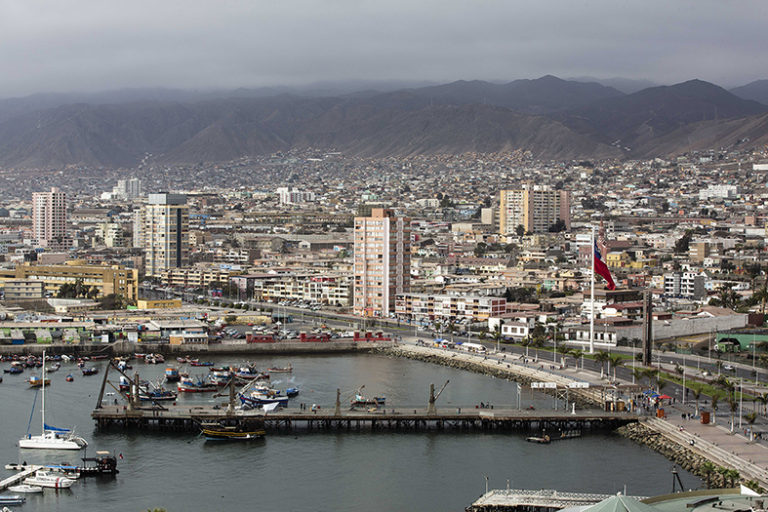
View of Antofagasta, Chile. Courtesy SACO Bienal
IBA Stage
SACO Bienal
May 13, 2022 (Friday)
10:00am (Antofagasta/GMT-4)
We are exited to return to the Latin American continent with IBA Stage with another voice from Chile. After the engaging presentation of the Santiago Biennial we venture into the north of Chile to hear about the experience of the SACO Bienal in Antofagasta.
SACO was created in 2012, in the city of Antofagasta. It began as a Contemporary Art Week, becoming an International Festival five years later and from 2021 it is the Contemporary Art Biennial of Chile. Its privileged location, in the driest desert in the world and under the most pristine skies on the planet, has allowed it to develop a solid residency program, coordinating projects that usually culminate in an exhibition that combines art with science or other study phenomena. Its priority is to establish horizontal meeting points to generate circulation between art and the community, deepening the creative processes as informal education tools, “outside the box”, promoting the transfer of knowledge, interculturality and exchange of ideas, designing models of social transformation through art with concrete actions both in cities and in smaller towns.
SACO‘s activities are based on three fundamental pillars:
– Museum without museum: temporarily occupying public and private infrastructures, open and closed, connected in a circuit of exhibition spaces.
– School without school: extensive informal artistic education program prioritizing children and youth.
– Territory: artistic residencies and transdisciplinary research.
SACO is a biennial born as a proposal to reduce the imbalance between the economic and the cultural local reality, establishing itself as a pole of reflection and artistic development in the world capital of copper and lithium extractivism.
Our actions take place in the driest desert and under the clearest skies on the planet, a territory marked by mining monoproduction and the abandonment of social and cultural policies. A “sacrifice zone” generated from difficult working conditions, pollution, environmental problems and migratory phenomena that have occurred during the last two decades in a territory of more than two thousand kilometers in extension where there are no museums or schools of art.
Each edition has its theme and its curatorial text, which forms the backbone of two years of work and ends with a bilingual editorial publication. Among the approximately 15 exhibitions and performative interventions of each edition, one is the result of the main international call, where 7 artists selected by a jury come to develop a site-specific in the Historic Pier of Antofagasta, while the rest is made up of curatorial projects, research steps and results of other specific calls. At least one of the exhibitions corresponds to a local artist(s). All the exhibitions have self-taught mediators trained and hired by the biennial, with which we contribute to the cultural labor field.
The art works that we exhibit have the character of work in progress and are the result of processes lived by the artists within the territory, in connection with the community, both in Antofagasta and in San Pedro de Atacama, a town historically connected to native cultures in the foothills of the Andes. The residencies accompanied by our permanent team allow creators to work directly with science in privileged areas of knowledge in the Atacama Desert, such as astronomy, geology, archeology or microbiology. The process normally involves two periods, an immersive residency during the non-exhibition year, and during the following one a public show.
Each exhibitor is asked to offer a pedagogical activity for the local community, as a symbolic act and retribution to the territory in which the artist investigates and interacts.
The biennial prioritizes the respect and well-being of local communities, so all projects considered as cultural extractivism, both towards native peoples, migrants, and other vulnerable groups, are excluded from our field of interest as an organization.
SACO has a center for artists in residence, offices and a small exhibition space. For the entire exhibition circuit of the biennial, it occupies allied spaces throughout the city, such as foundations, universities, institutes, museums, schools, advertising spaces, private parking lots and public spaces in general.
To register please follow the link below:
https://us02web.zoom.us/meeting/register/tZcudu6hpjojH9YWAPKcPRHElUJQjMeAtnYd