
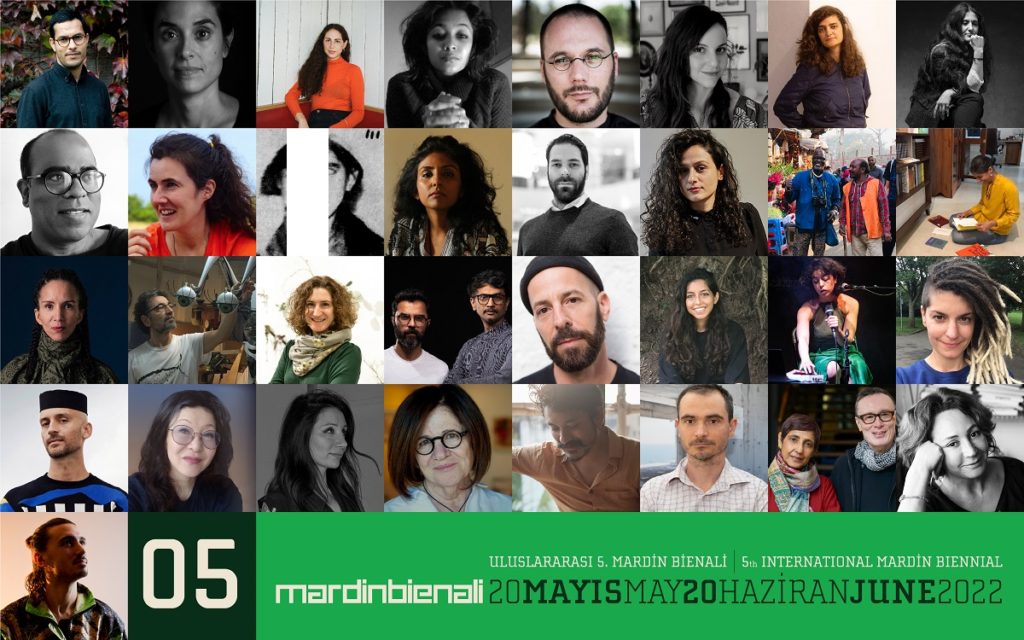
Image courtesy of Mardin Biennial.
5th Mardin Biennial
The Promise of Grass / The Gift of Dispossession
May 20, 2022 – June 20, 2022
https://mardinbienali.org/en
The forthcoming fifth edition of the biannual contemporary art presentation in Mardin will take place from 20 May – 20 June, 2022. With a focus on the Levant — the cradle of civilisation — and its allied geographies along the ancient silk route, the exhibition will see a gathering of over 30 artists from Turkey and beyond, representing around 25 countries. Their works bring the edaphic generosity of the region as well as its syncretic bindings to bear upon its fraught present. Spread across four main venues in the old town, with a few spill-overs, the exhibition will open to the public free of charge from 20 May onwards. Through the course of the exhibition border_less, an independent archiving and publishing platform, will be keeping a cosy reading space at Sahaf Kebikeç for those who seek an extended engagement with the exhibition contents. ‘The Promise of Grass / The Gift of Dispossession’ is curated by Adwait Singh.
Set against the swelling tide of disenfranchisements as well as a literal rise in sea level, the exhibition will indulge the counterintuitive notion of dispossession as a gift, wagering hopes for an economy of renouncement. The recent spate of proletarian movements the world over can be interpreted as a reaction to the consolidation of crisis-capitalism as the governing logic of our times. The globalisation of capitalist enclosure, or its corollary, the privatisation of security, can be gathered from the pervasive phenomenon of gated societies, surveillance networks, integrated databases, hostile architecture, floating sea barriers and carceral systems. As a result a vast majority is finding itself progressively locked out. Indeed, globalisation—the universal outreach that sought to unite us across socio-cultural differences—has been systematically appropriated by statist ideologies that terrorise the masses with the imagery of immigrant hordes waiting to overtake their jobs, social security and way of life. Ironically, these divestments are in fact enacted by the selfsame regimes using globalisation as a scapegoat. How do we resolve this impasse between capitalist encroachments on the one hand, and growing deprivation on the other?
Our provocation is that globalised dispossession need not be an existential dead-end and can instead denote the juncture where capitalist territorialisation having come a full circle, finds its operational logics inexplicably reversed. The exhibition will call into question the biopolitical instrumentalizations of uprooted bodies, recalling us to the fact that not only has migration played a fundamental part in our evolution but has also been historically valued as a source of cultural exchange and social vitality. In wandering renouncement, will be revealed the seeds of a new order based on the principles of non-filial sociality, parcelised sovereignty, and creative commoning. If the monopolistic proclivities of capitalism are to be blamed for poisoning the land and its various gifts, then it stands to reason that a propitiatory gesture must follow mystical lines of love that stake parts to reclaim the whole. It would, in other words, demand a volitional dis-individuation and decolonisation of the self. Taking dispossession to be a prerequisite for liberation, one can slowly start mustering the ruins into a shared internal resource for issuing new currencies centered around empathy, care, and egalitarianism.
Returning to the idea of gift economies that function in the spirit of barter, largesse, and reciprocity, the exhibition will transmit histories, cosmologies, futurisms, experiments, and songs of the dispossessed that espouse alternative perspectives on ownership, exchange, and relationality. Such a moment is within grasp as we witness glitches in a system showing signs of overload. The flickering social ecologies from the Cooperative of Somankidi Coura (Mali) to the penitentiaries of Tibet, have come to symbolise both the laboratories where new models of sovereignty and co-existence are being tested, as well as the focal points of sanctioned violence. In myriad mystical tongues, their selfassured and wilful resilience sings to us the promise of grass.
Participating Artists
Abdessamad El Montassir (Morocco / France), Almagul Menlibayeva (Kazakhstan / Germany), Asunción Molinos Gordo (Spain / Egypt), Bhagwati Prasad (India), Bouba Touré (France / Mali) with Raphaël Grisey (Germany), Deniz Uster (UK / Turkey) with Burcu Yağcıoğlu (Turkey), Bint Mbareh (Palestine / UK), E.B. Itso (Denmark), Fatoş Irwen (Turkey), Gülsün Karamustafa (Turkey), İpek Hamzaoğlu (Turkey / Austria), Jonas Staal (Netherlands), Kamen Stoyanov (Bulgaria), Karan Shrestha (Nepal/ India), Kathyayini Dash (India / South Africa), Lara Ögel (Turkey), Marwa Arsanios (Lebanon / Germany), Merve Ünsal (Turkey), Mikhail Karikis (Greece / UK), Nandita Kumar (India / Aotearoa), Neda Saeedi (Iran / Germany), Nejbir Erkol (Turkey), Ömer Pekin (Turkey), Rakhi Peswani (India), Ritu Sarin and Tenzing Sonam (Tibet / India), Sasha Huber (Haiti / Switzerland / Finland), Selma Gürbüz (Turkey), Server Demirtaş (Turkey), Sibel Horada (Turkey), Thukral and Tagra (India), Uriel Orlow (Switzerland), Zahra Malkani (Pakistan) Burak Özdemir (Germany) Michael Rakowitz (USA)
Exhibition Curator
Adwait Singh (b. 1992) is a New Delhi-based curator and theorist engaging affective historiography, queer epistemology, and ethno-cosmologies with the view to qualify predominant understandings and modes of relating to the world. Theirs is an integrative practice that seeks to promote collective care, commensality, and dialogue within the arts ecology. Parallel to the Mardin Biennial, they have been working on the 14th edition of the historical Queer Arts Festival in Vancouver (June 2022) that pitches a mutational politics as a counter to neo-colonial technics of exposure and their monitored replication of the status quo. Other significant projects include ‘Mutarerium’ which questioned the terminology of the Anthropocene by examining a trifecta of more-than-human evolutionary timelines at the Mumbai Art Room (Mumbai, 2019) and ‘Caressing History’ that explored the possibility of a para-textual, embodied historiography at Prameya Art Foundation (New Delhi, 2018). Their writings have appeared in various publications and periodicals.