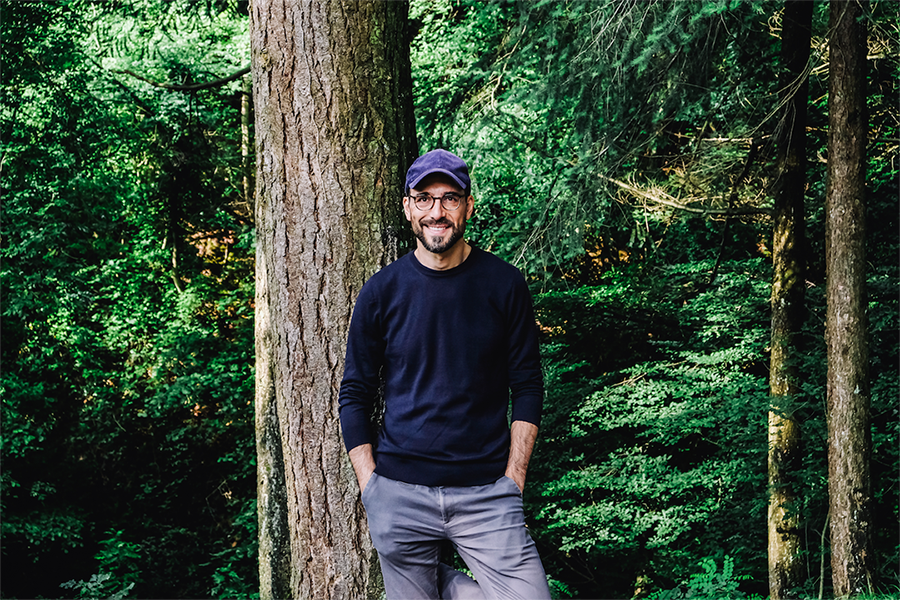
Lorenzo Giusti, Curator of “Parliament of Marmots” – 9th Biennale Gherdëina. Photo: Paolo Biava. Courtesy Biennale Gherdëina
IBA Stage: 9th Biennale Gherdëina
July 16, 2024 (Tuesday)
10:00 am (Ortisei/GMT+2)
We are delighted to present our first guest for the upcoming IBA Stage: Lorenzo Giusti, curator of the The Parliament of Marmots. It is a pleasure to have Lorenzo with us discussing his vision for the 9th Biennale Gherdëina as well as giving us insights into how the project came along in this very unique setting. The Parliament of the Marmots is a project building on ancient local myths and the relation between human and (super)natural forces they describe, vis-a-vis the current dichotomy of human environment and wilderness.
Following is a longer passage from the curatorial text which gives us a more in-depth view on Lorenzo’s thinking while approaching the subject:
The Legend of the Fanes – one of the most fascinating Ladin myths of the Dolomites, reconstructed at the beginning of the last century by the Austrian writer Karl Felix Wolff – tells the story of a meek and peaceful populace whose kingdom extended beyond the seven mountains and seven marshes to the edge of the world. The secret behind the prosperity of this population lay in their alliance with the marmots, of whom the Fanes were indeed descendants, for it was among those animals – entrusted to them by Anguana, the water nymph – that their foremother Moltina had been brought up.
When the alliance was broken because of a princess ashamed of her people’s pact with the animals, the Fanes met with misfortune and conflicts that led to the decline of their kingdom. The few survivors thus hid away in a cave beneath the rocks, from where to this day, together with the marmots, they wait for the silver trumpets to sound, heralding their rebirth.
The beliefs underlying the Dolomitic legends have deep roots, going back to the times of protohistory, to the passage from small groups of hunters and gatherers to the first organised communities of breeders and farmers. They are totemic structures that tell of the complex relationship of these archaic societies with the theme of the soul, whose presence pervades all the main entities of living nature in its freest and wildest dimension.
But just what does it mean today ‘to be wild’? Where can we still find some form of natural freedom, on a planet where pristine habitats no longer exist? And what lessons can we learn from these realities? What spaces will the ruins of capitalism reserve for wild nature? What possibilities of life and what forms of survival? All these questions have guided the planning of Biennale Gherdëina 9 and – in various ways, trajectories and temporalities – the work of the artists called upon to take part.
Brought into our time, the archetypal alliance with marmots opens up a reflection on the disruption of the interspecies balance perpetrated by contemporary civilisation. From an analysis of our relationship with non-human animals, we can understand much about the more general crisis of the human pact with nature in its entirety, but also about the forms of discrimination, control and violence that afflict the human species internally. This is why the anti-speciesist theses proposed in the mid-1970s by authors such as Peter Singer are still able to question our thinking in depth. Theses that, in more recent times, have been integrated and reworked as part of philosophical reflections, new anthropological studies and interspecies narratives that have come to embrace the entire sphere of the living today.
In reconstructing the ancient tales of the Dolomite oral tradition, Karl Felix Wolf drew on Nordic mythology – of which the culture of his time was permeated, also serving the promotion of the Austro-Hungarian imperial myth – losing sight of the strong link between these tales and ancient Mediterranean narratives. Dolasilla herself, the main heroine of the Fanes saga, whom Wolff describes as a kind of conquering Valkyrie, seems to have much in common with the figure of the sidereal Artemis: the Greek Goddess of the Moon, who appears in the guise of a huntress to protect the fertility of nature.
The Ladin legends are not about creation – be it of human beings or empires – but about transformation, metamorphosis and contamination, celebrating wild nature, the ‘life-death-life’ cycle and the complex and profound relationship between the various species of the living world. Rereading the myths from this perspective, the Dolomites – these monumental rocky ridges resurfaced from the sea, these remnants of gigantic coral reefs that surfaced 250 million years ago – from being a barrier, stronghold or border become a place of encounter, of mending and contamination.
By superimposing onto the background of the ancient Dolomitic legends new tales of mountains, woods, migration, animality and inter-species alliances, The Parliament of Marmots embraces a field of investigation that, along with the European continent, extends as far as the Mediterranean territories of North Africa and the Middle East, from which the totemic structures at the heart of the Ladin myths themselves seem to have derived to a large extent.
According to anthropologist Anna Tsing, the ability to create worlds is not the prerogative of humans, which is why we need to turn to ways of making worlds or modes of existence beyond the human. This does not mean adopting a post-human perspective – in which the human element disappears – but rather opening up to the telling of ‘more-than-human’ stories, in which humans lose their centrality, in the knowledge that no organism can become itself without the assistance of other species.
Seeking to piece back together a possible vision of these worlds, Biennale Gherdëina 9 presents a hybrid mosaic of artistic proposals, opening up scope for a cultural and political reconnection between the Alps and the Mediterranean, between origins and perspectives, and de-conceptualising the idea of nature in favour of a narrative, existential dimension of the savage in the age of the ‘Capitalocene’.
Lorenzo Giusti (PhD) is an art historian and curator, a mountain enthusiast and lover of walking in natural spaces. After serving as director of the MAN Museum in Nuoro (2012-2017), currently he is the director of GAMeC – Gallery of Modern and Contemporary Art in Bergamo, where, along with numerous solo exhibitions, he has conceived and co-curated the long-term multidisciplinary programs The Trilogy of Matter (2018-2023) and Thinking Like a Mountain (ongoing) and founded, during the pandemic crisis in 2020, the digital platform Radio GAMeC. As an independent curator, he staged exhibitions, edited publications or collaborated in different roles with several public and private institutions and organizations, including Kunsthaus Baselland, Mumok Vienna, Art Dubai, Venice Biennale, Artissima Turin, Vienna Curated by Festival, Palazzo Grassi-Punta della Dogana in Venice, OGR Turin, Shenzhen Animation Biennale, FRAC Corse, Triennale Milano, Palazzo Strozzi in Florence and others. His special interests lie in the relationship between historical avant-gardes and contemporary languages and practices as well as between ecological thinking and the contemporary arts.
To have the possibility to hear and discuss with the individuals behind biennials has been a key component of what we believe IBA can offer to our members and the wider public and we value your participation through our live streams. As always IBA Stage events are meant as a moment to hear about a project through its makers and have the opportunity to participate in a Q&A session at the end of the presentation.
Click here to register for the event or follow us through our usual social media channels.