
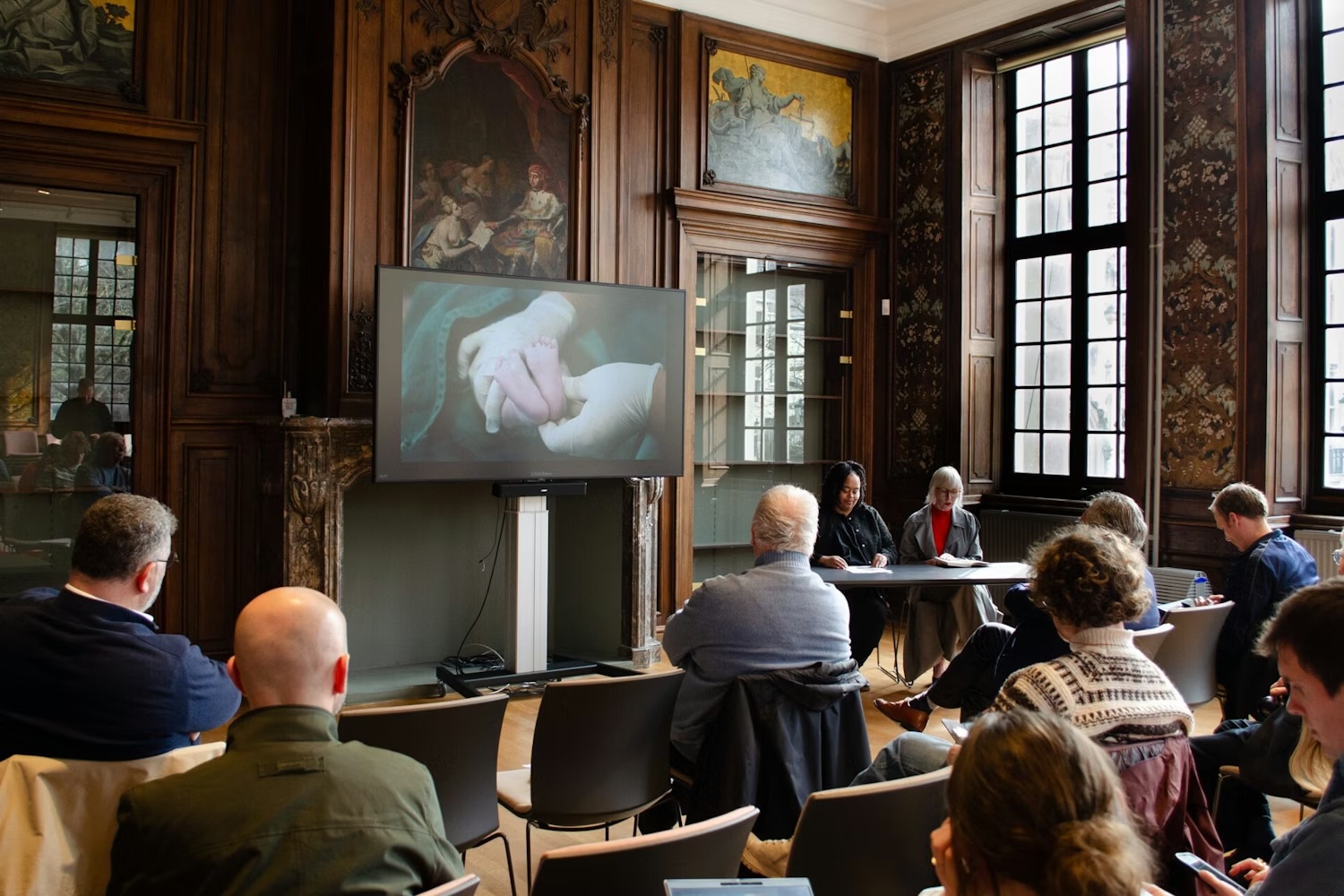
Presentation of TRIBRU27 – After Birth – Structures of Togetherness. Courtesy TRIBRU
Triënnale Brugge 2027 Announces Theme: After Birth – Structures of Togetherness
April 24 – September 5, 2027
Bruges, Belgium
https://triennalebrugge.be/en/
Triënnale Brugge has announced the theme of its fifth edition, After Birth – Structures of Togetherness, which will take place from April 24 to September 5, 2027, transforming the historic city of Bruges into a stage for contemporary art and architecture.
Set within the unique urban fabric of this UNESCO World Heritage city, the exhibition unfolds as an open-air parcours, bringing together artistic and architectural interventions that engage directly with public space. The 2027 edition focuses on questions of togetherness, shared rituals, and collective life, offering a counterpoint to the increasing individualisation of contemporary society.
Curated by Ulrika Flink and Helen Rix Runting, the Biennale takes as its starting point the observation that Bruges has long been shaped by structures of collective living, from monasteries and hospitals to schools and care institutions, forming a historical framework for thinking about how communities are organised and sustained.
The theme After Birth – Structures of Togetherness proposes a reflection on the full arc of life, structured across a series of chapters that move from birth to death. Within this framework, artists and architects explore how art can contribute to new modes of coexistence, care, and relationality.
For the first time in the history of Triënnale Brugge, a number of projects will emerge from explicit collaborations between architects and visual artists, developed through dialogue and shared research. These works do not necessarily merge into singular forms but instead reflect a process of exchange and co-creation. The exhibition also expands the notion of site-specificity. Rather than being fixed to a single location, some works will unfold across multiple sites or remain intentionally fluid, questioning how we define place, presence, and spatial experience.
Throughout the exhibition period, installations will be activated through performances, music, lectures, and public programmes, allowing new meanings and encounters to emerge over time. This dynamic approach positions the exhibition as a living framework rather than a static display. At the same time, the Biennale reflects on the afterlife of its interventions, exploring how temporary works can contribute to longer-term visions for urban space. Through strategies such as material reuse, relocation, and circular thinking, After Birth engages with questions of sustainability and continuity beyond the exhibition’s duration.
Over five months, Bruges will become a site for exchange, participation, and dialogue, supported by an extensive programme developed in collaboration with local and international partners. Triënnale Brugge 2027 will also build on its ongoing collaborations, including a renewed partnership with Triënnale Beaufort. A joint installation will be launched in Zeebrugge in March 2027, preceding the official opening and marking the first chapter of the Biennale.
Further details, including participating artists and architects, will be announced in autumn 2026.