
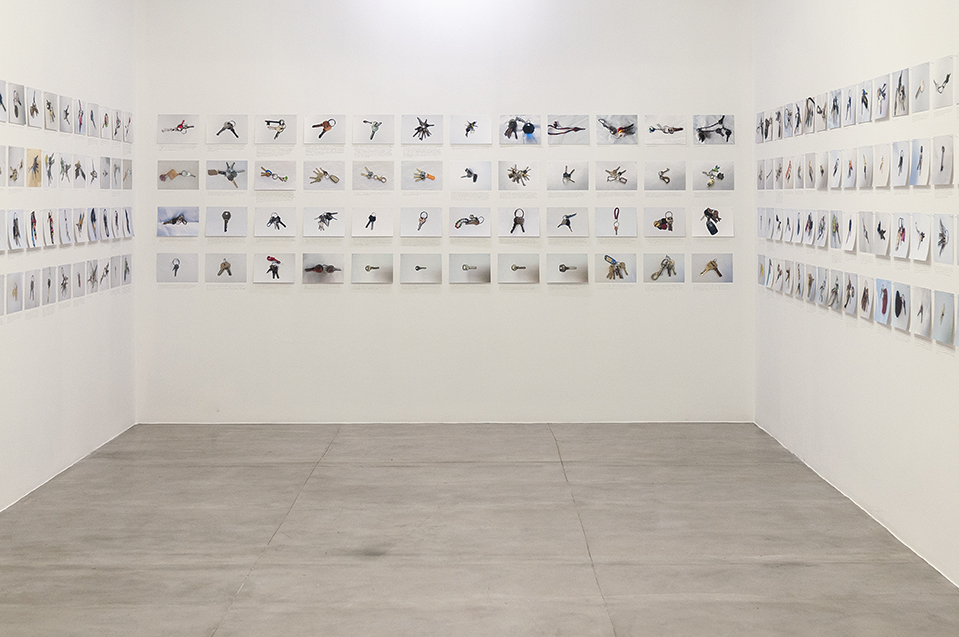
Taysir Batniji, Just in Case #2. Círculo Sereia. Courtesy Anozero Coimbra
IBA Stage: Anozero’26 — To hold, to give, to receive
September 3, 2026 | 4:00 PM Coimbra Time (GMT+1)
Online via Zoom
For the next edition of IBA Stage, we travel to Coimbra, Portugal, for a conversation around Anozero — Bienal de Coimbra – To hold, to give, to receive, which took place across the city from April 11 to July 5, 2026.
On September 3 at 4:00 PM Coimbra time (GMT+1), we will be joined by Carlos Antunes, Director of Anozero — Bienal de Coimbra and Círculo de Artes Plásticas de Coimbra (CAPC); Hans Ibelings and John Zeppetelli, curators of Anozero’26; and Daniel Madeira, Assistant Curator of Anozero’26 and Assistant Director of Anozero and CAPC.
We will look back at the recently concluded edition while exploring the particular institutional and curatorial model that has developed around Anozero, its relationship with the city of Coimbra and its architectural heritage, and the ideas of reciprocity, hospitality, mutual aid, and collective inhabitation that shaped To hold, to give, to receive.
Established in 2015 by Círculo de Artes Plásticas de Coimbra, Coimbra City Council, and the University of Coimbra, Anozero was conceived by Carlos Antunes following the classification of the University of Coimbra, Alta and Sofia as a UNESCO World Heritage Site. From its beginnings, the Biennial has approached contemporary art as a means of activating and critically reflecting upon heritage spaces and the historical, cultural, and political dimensions embedded within the built environment.
This relationship between contemporary practice, architecture, and heritage remained central to Anozero’26. Curated by Hans Ibelings and John Zeppetelli, with Daniel Madeira as Assistant Curator, To hold, to give, to receive brought together artists, architects, filmmakers, and research-based practitioners across eight locations in Coimbra, with the Mosteiro de Santa Clara-a-Nova once again serving as its principal venue.
The curatorial framework took as its point of departure the Proto-Indo-European root ghabh, from which the word “habitat” derives and whose meanings include to hold, to give, and to receive. From these three gestures, the Biennial considered giving and receiving as fundamentally shared acts, asking how generosity, reciprocity, symbiosis, mutual aid, and hospitality might take form through art and architecture and, ultimately, what it means to share the world.
Drawing on Peter Kropotkin’s concept of mutual aid, the exhibition proposed collaboration, interdependence, and horizontality as alternatives to individualism, competition, and polarisation. Rather than understanding an exhibition as a fixed container for individual works, Anozero’26 approached it as a living and relational environment in which artworks, architecture, audiences, histories, and ideas could coexist and interact.
This expanded understanding also allowed the Biennial to question conventional distinctions between creative disciplines. Art, architecture, design, craft, landscaping, folklore, and gardening entered the exhibition as interconnected forms of practice, opening the possibility of thinking about cultural production through exchange, care, and interdependence rather than established hierarchies.
The architecture and history of Coimbra itself became an active part of this proposition. At the centre of the Biennial, the seventeenth-century Mosteiro de Santa Clara-a-Nova carries successive histories as a religious sanctuary, military barracks, and contemporary cultural space. Rather than functioning simply as a backdrop for the exhibition, the building became an interlocutor for the works presented within it. Beyond the monastery, Anozero extended through Círculo Sede, Círculo Sereia, Sala da Cidade, Edifício Chiado, Convento São Francisco, Jardim Botânico, and MUSEU, allowing different parts of Coimbra to become part of the exhibition’s spatial and conceptual fabric.
Curators Hans Ibelings and John Zeppetelli bring together backgrounds in architecture, contemporary art, institutional practice, writing, and moving image. Ibelings teaches at the Daniels Faculty of Architecture, Landscape and Design at the University of Toronto and has curated architectural exhibitions since 1989, while Zeppetelli has held senior curatorial and directorial positions at institutions including the Musée d’art contemporain de Montréal, the Art Gallery of Ontario, Phi Foundation, and ICA London.
Tis edition of IBA Stage will offer an opportunity not only to look back at To hold, to give, to receive, but also to consider the wider questions it raises around how biennials inhabit cities, engage with existing architectures and histories, and create spaces for exchange between artworks, institutions, audiences, and communities.
Join us online on September 3 at 4:00 PM Coimbra time (GMT+1) for the next IBA Stage.