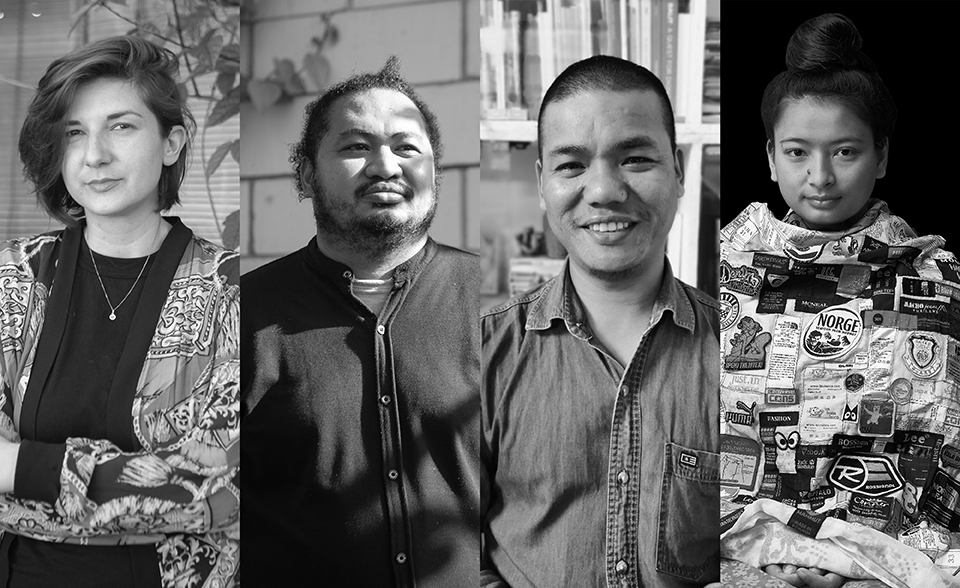
Curators of Biennale Jogja 17: (from left) Adelina Luft, Eka Putra Nggalu, Hit Man Gurung and Sheelasha Rajbhandhari. Courtesy Biennale Jogja.
IBA Stage: 17th Biennale Jogja
October 27, 2023 (Friday)
5:00pm (Yogyakarta/GMT+7)
We are excited to have with us Eka Putra Nggalu, Adelina Luft, Sheelasha Rajbhandhari and Hit Man Gurung, curatorial team of the 17th Biennale Jogja who have developed, together with the biennial’s director Alia Swastika, the framework for this year’s edition under the title: Titen: Embodied Knowledge, Shifting Grounds. Their presence during our conversation will certainly allow us to discuss their project under many different perspectives giving us a sense of what each of them brought to it and how the collaboration unfolded throughout the months leading up the exhibition.
In a previously published post on our site they had shared some brief comments which we are reposting here to give you a sense of their approach and set the scene for the discussion on Friday:
“The recent multi-disciplinary efforts developing simultaneously in the Global South and Eastern Europe emphasize the need and urgency to reassess the political (and cultural) dynamics and intersections between the (post)socialist and postcolonial worlds by displacing the binary axes of analysis inherited from the Cold War. In this way we can reveal alternative routes and locations where decolonial politics emerge(d) and strive(d). Acting as a binder between these specific localities, the curatorial framework builds from our inter-related positions as embodied peripheral selves. It departs from existing archives and histories, not to reveal de facto what has been materially erased or hidden historically, but to weave new narratives from a present and critical lens through interdisciplinary and collaborative propositions: reinscribing the collective female voice from the history of the Non-Aligned Movement; carrying on the values of the Yugoslav self-organized and self-sustained principles and forms of organization in the act of revitalising heritage architecture; making and performing collectivities and communalities”. Adelina Luft
“These things include the efforts to read women’s movements, queer movements, artists, activists and other social actors as well as awareness to discuss the village as a specific unit in which active citizen participation is intertwined as part of a cultural and bureaucratic community. With our experiments at the Biennale Jogja 17, even in places called ‘villages’ we wish to create a ‘pause’ that brings together all the screws from the field of contemporary art and cultural production. Projects stretch a spectrum of trans-locality with its various contexts, with the aim to to learn from each other, connect, share, build cross-border solidarity which may evolve into a social movement that supports each other and reinforces these screws in the cultural arts field that imagines collectively”. Eka Putra Nggalu
“The future of knowledge should be referred to the indigenous life, that spans from origin stories of care, kinship, spirits, resource sharings, shamanistic and nature based practice, and so on. Our curatorial practices in this Biennale Jogja 17 will acknowledge the local images and object making practices as a decolonial praxis that weaves the new realities constructed from migration, mobility, resistance, urbanisation and displacement. Working with artists and local communities from various backgrounds have led us to collaboratively imagine the non-fundamentalists, non-monolithic, plural approaches in our cultural activism to reclaim memory and identity.” Hitman Gurung and Sheelasha Rajbhandhari
As always IBA Stage events are meant as a moment to hear about a project through its makers and have the opportunity to participate in a Q&A session at the end of the presentation.
Click here to register for the event or follow us through our usual social media channels.