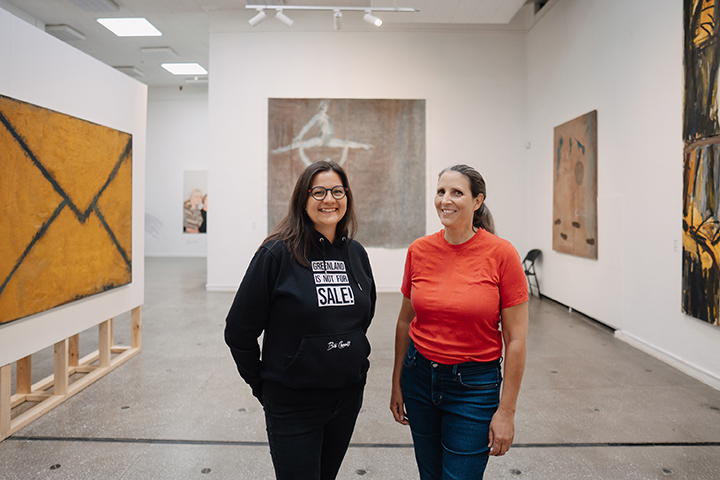
16th Kaunas Biennial Curators: Nivi Christensen, Josée Drouin-Brisebois. Photo: Martynas Plepys. Courtesy Kaunas BIennial
Josée Drouin-Brisebois and Nivi Christensen to Curate the 16th Kaunas Biennial
16th Kaunas Biennial
17 September – 21 November 2027
Kaunas, Lithuania
We are pleased to share that Josée Drouin-Brisebois and Nivi Christensen have been appointed curators of the 16th Kaunas Biennial, taking place in Kaunas, Lithuania, from 17 September to 21 November 2027.
The upcoming edition will mark an important moment for our IBA member Kaunas Biennial as it celebrates its 30th anniversary, bringing together three decades of activity with a new curatorial perspective that looks towards the future of the organisation and its relationship with the city.
For the 16th edition, Kaunas Biennial brings together two curators with distinct experiences and relationships to the biennial. Canadian curator Josée Drouin-Brisebois returns to Kaunas after curating the 13th Kaunas Biennial, while Nivi Christensen, Director of Nuuk Art Museum in Greenland, will encounter Lithuania and Kaunas for the first time.
As Renata Bartusevičiūtė, Director of the Kaunas Biennial, explains:
“As the Kaunas Biennial approaches its 30th anniversary, we felt it was important to reflect on its accumulated experience while also looking to the future. Our choice of curatorial duo reflects this connection. Josée curated the 13th Kaunas Biennial – she knows the city, its cultural scene and its audiences. Nivi, meanwhile, is visiting Lithuania for the first time. She brings with her experience of Greenland’s cultural scene and a perspective from a region that has not previously been explored in our program. We hope that bringing these two curatorial perspectives together will offer new ways of seeing both Kaunas and the biennial itself,”
The main exhibition will bring together artists investigating experiences of place, belonging and resistance. Working across a variety of media the participating artists will address histories of labour, care and intergenerational connection, alongside questions of Indigenous identity and colonial memory connected with reflections on communities, nature and land.
Central to the developing curatorial proposition is an understanding of solidarity and care as active political practices. Rather than approaching solidarity as something given from a position of power, the exhibition will consider how it might emerge from peripheral positions and from the experiences of those who are present but often remain unseen. This extends beyond human communities to consider land, nature and the relationships between past and future generations.
Against a wider context in which established certainties are increasingly being destabilised, the project asks how spaces for genuine comfort, care and common understanding might be built. It will develop through dialogue with artists, landscapes and histories that continue to unfold.
As Drouin-Brisebois and Christensen state:
“We are interested in solidarity as a practice – a way of listening, acknowledging differences, sharing responsibility and acting together,”
Alongside the main exhibition, the 2027 program will celebrate 30 years of Kaunas Biennial through a dense progarm to celebrate the event. Together, these programs will revisit the organisation’s history, its relationship with Kaunas, its place within Lithuania’s contemporary art scene and its wider contribution to the biennial model.
The anniversary also returns attention to the Biennial’s origin. Its history began in 1997 with the international exhibition TEXTILE ’97, organised in Kaunas as a platform for developments and experimentation in textile art across the Baltic countries. Over the following three decades, the organisation developed into one of Lithuania’s largest and longest-running international contemporary art events.
Josée Drouin-Brisebois is Director of National Engagement at the National Gallery of Canada, where she previously served as Senior Curator of Contemporary Art. Between 2011 and 2019, she contributed to exhibitions presented in the Canada Pavilion at the Venice Biennale. Her curatorial practice has included exhibitions in Canada, Italy, Austria and Lithuania.
Nivi Christensen is Director of Nuuk Art Museum in Greenland. Alongside curating exhibitions and advising on art projects in Greenland and internationally, she is a guest lecturer at the University of Greenland, Ilisimatusarfik. Her work places particular emphasis on strengthening Greenland’s local art scene and developing connections between representatives of Indigenous cultural scenes across the Arctic region.
Bringing these two perspectives together, the 16th Kaunas Biennial will use its anniversary not only as an occasion to reflect on its history, but also as a point from which to consider new forms of solidarity, connection and collective responsibility.
The list of participating artists and the full program for the 16th Kaunas Biennial will be announced in the coming months.