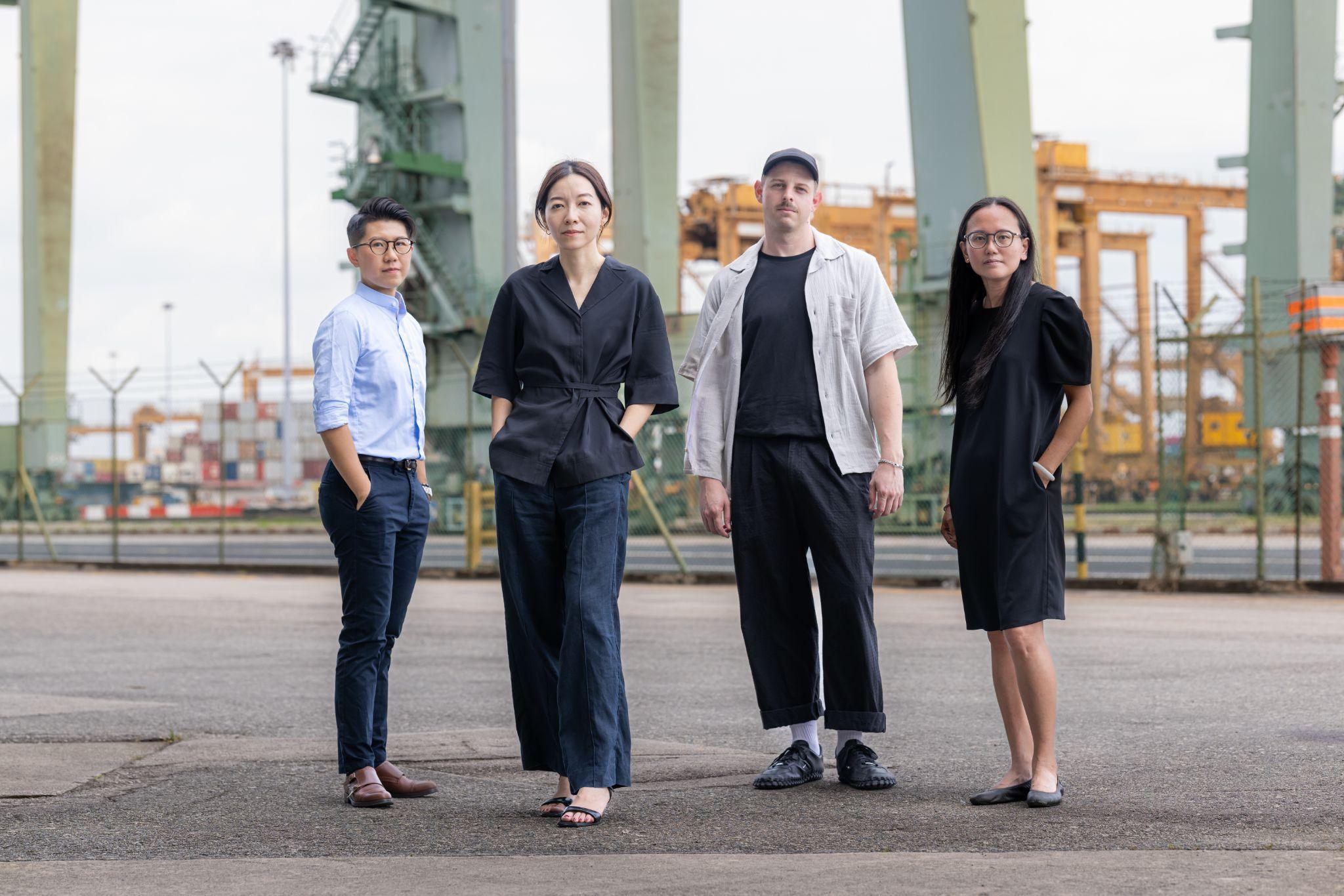
(From Left to Right) Singapore Biennale 2025’s curatorial network, including curators Hsu Fang-Tze, Selene Yap, Duncan Bass, and Ong Puay Khim, has invited a range of independent organisations and curatorial collectives to bring ‘pure intention’ into meaningful dialogue with diverse audiences.
8th Singapore Biennale
pure intention
October 31 2025- March 29 2026
Singapore Biennale
The Singapore Biennale returns in October 2025 with its eighth edition, themed pure intention. Organized by the Singapore Art Museum (SAM) and commissioned by the National Arts Council (NAC), Singapore Biennale 2025 (SB2025) will unfold from 31 October 2025 to 29 March 2026, coinciding with Singapore’s 60th year of independence (SG60). This anniversary will certainly set the stage for a Biennale that engages with Singapore’s urban transformation, collective histories, and future aspirations.
Unlike previous editions, SB2025 moves deeper into Singapore’s public and everyday spaces, reimagining the urban fabric by showing contemporary art in parks, historic landmarks, and even shopping centers. For the first time, Fort Canning Park and the Rail Corridor will play a significant role as exhibition sites, offering audiences new ways of engaging with art outside traditional museal settings. This curatorial approach invites the public to see the city anew, reflecting on the intersection of tradition and modernity while uncovering hidden layers of Singapore’s identity.
This edition of the Biennale embraces a curatorial network model, coordinated by Duncan Bass, Hsu Fang-Tze, Ong Puay Khim, and Selene Yap. Moving beyond the traditional single-curator approach, this network fosters collaborations with independent organizations and curatorial collectives. Among the contributors are Asian Film Archive (Singapore), Hothouse (Singapore), Hyphen— (Indonesia), SAVVY Contemporary (Germany), and The Packet (Sri Lanka).
Together, these curatorial practices bring diverse perspectives on urban transformation, collective memory, and the role of art in shaping public consciousness. As stated by the curators: “pure intention facilitates deep engagement with Singapore’s rapidly changing social and urban environment, inviting reflection on the intersection of tradition and modernity.” Their vision for SB2025 highlights art’s potential to reshape perceptions of place, history, and identity while fostering critical conversations on belonging and the city’s evolving landscape.
SB2025 builds on Singapore Biennale’s legacy of bridging local and international audiences through contemporary art. By incorporating site-responsive works in public spaces, the Biennale reaffirms its commitment to accessibility and engagement. Whether in a park, a historic site, or a bustling commercial area, these artistic interventions will challenge viewers to rethink their relationship with familiar environments.
Eugene Tan, Director of Singapore Art Museum, emphasized this approach: “Through the distinct vision of the Biennale’s curatorial network, we will meet audiences where they are by embedding artistic presentations in spaces of everyday life.” The Biennale thus extends beyond the traditional exhibition model, embracing art as an organic part of city life.
About the Singapore Biennale
The Singapore Biennale was established in 2006 as the country’s pre-eminent platform for international dialogue in contemporary art. It presents and reflects the vigour of artistic practices in Singapore and the region within a global context, and fosters productive collaborations and deep engagement with artists, arts organisations, and the international arts community.
The Singapore Biennale cultivates public engagement with contemporary art through a period of concerted activities including exhibitions, public engagement and education programmes that feature artist and curator talks and tours, school visits and workshops, and community days. It complements achievements in other areas of arts and culture, collectively enhancing Singapore’s international profile as a vibrant city in which to live, work and play.
The 2006 and 2008 editions of the Biennale were organised by the National Arts Council (NAC). NAC has commissioned SAM to organise the Biennale since 2011.
About Singapore Art Museum
Singapore Art Museum opened in 1996 as the first art museum in Singapore located in the cultural district of Singapore. Known as SAM, the museum presents contemporary art from a Southeast Asian perspective for artists, art lovers and the art curious in multiple venues across the island, including a new venue in the historic port area of Tanjong Pagar.
The museum is building one of the world’s most important public collections of Southeast Asian contemporary art, with the aim of connecting the art and the artists to the public and future generations through exhibitions and programmes. SAM is working towards a humane and sustainable future by committing to responsible practices within its processes.
To find out more, visit www.singaporeartmuseum.sg.
Further details about participating artists, specific venues, and public programs will be released later in 2025. However, SB2025 already signals an ambitious shift toward art as an active presence in the city’s daily life. By embedding artistic experiences in Singapore’s diverse urban landscape, the Biennale reaffirms its relevance as a dynamic platform for dialogue and discovery—one that resonates both locally and globally.
For more updates, visit the Singapore Biennale website or follow the Singapore Art Museum’s official channels.