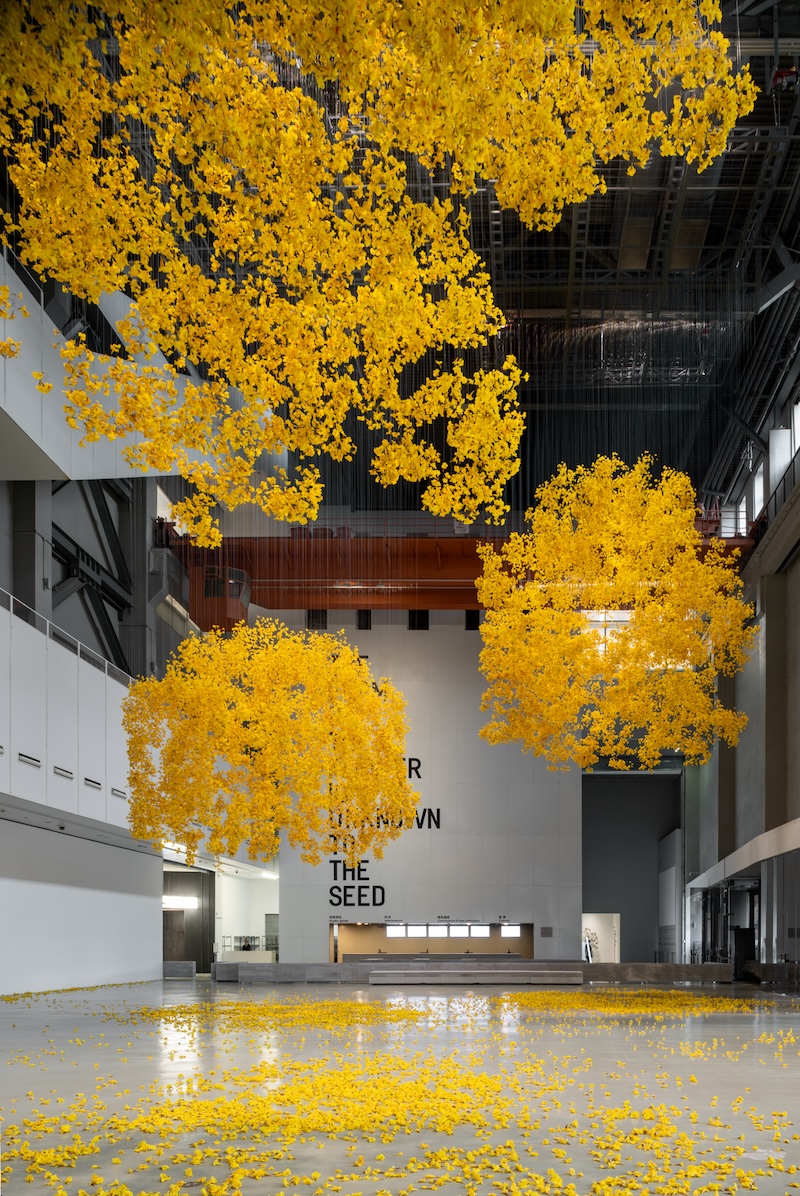
Allora & Calzadilla, Penumbra and Phantom Forest at the 15th Shanghai Biennale, Does the flower hear the bee?, 2025, Power Station of Art. ©Allora & Calzadilla. Courtesy of the artist, Lisson Gallery, Galerie Chantal Crousel, and Kurimanzutto. Image courtesy of Power Station of Art.
15th Shanghai Biennale – Does the flower hear the bee?
On view: 8 November 2025 – 31 March 2026
Venue: Power Station of Art, Shanghai
Chief Curator: Kitty Scott
Co-curators: Daisy Desrosiers, Xue Tan
City Projects: Jia Yuan Hai Art Museum; VILLA tbh, Shanghai; Shanghai Botanical Garden – Penjing Garden; klee klee & friends
www.powerstationofart.com
The Shanghai Biennale returns with its fifteenth edition, Does the flower hear the bee?, that opened on 8 November 2025 at the Power Station of Art. Bringing together more than 250 works by 67 artists and collectives from around the world, including 16 artists from China, this edition presents over 30 newly commissioned works, positioning recent art as a space for sensing, attunement, and interconnection across human and nonhuman forms of intelligence.
Curated by Kitty Scott, with Daisy Desrosiers and Xue Tan as co-curators, and Long Yitang and Zhang Yingying selected through PSA’s Emerging Curators Project, the exhibition unfolds across the museum and throughout the city via an expanded program of City Projects and public initiatives. Exhibition design is led by all(zone) / Rachaporn Choochuey, with graphic design by Sara De Bondt and editorial direction by Sarah Demeuse.
Taking its title from the poetic question Does the flower hear the bee?, the biennale explores how different forms of intelligence, human and nonhuman, might intersect, resonate, and co-exist. Like a flower that “hears” the vibration of wings, the exhibition proposes art as a privileged site for investigating emergent forms of perception, communication, and community formation within what the curators describe as the “more-than-human world.”
Set against a backdrop of global uncertainty, accelerating transformation, and ecological crisis, the biennale acknowledges a widespread sense of disorientation. Rather than offering resolution, it proposes art as a pathway through uncertainty, opening space for new sensorial registers, emergent forms of life, and hopeful orientations toward an unknown future. Developed in dialogue with artists, curators, intellectuals, poets, musicians, scientists, and writers, the exhibition puts attentiveness, listening, and embodied experience in the foreground as vital tools for navigating contemporary life.
The 15th Shanghai Biennale features works by 67 artists:
Kim Adams; Abbas Akhavan; Allora & Calzadilla; Francis Alÿs; Ryoko Aoki; Carmen Argote; Shuvinai Ashoona; Alvaro Barrington; Lêna Bùi; Tania Candiani; Maxime Cavajani; Carolina Caycedo; Chen Ruofan; Cheng Xinhao; Sara Cwynar; Dan Er; Rohini Devasher; Miguel Fernández de Castro; Cristina Flores Pescorán; Theaster Gates; Abraham González Pacheco; Brett Graham; Hao Liang; d harding; Ho Tzu Nyen; Ngahina Hohaia; Hu Xiaoyuan; Huang Yongping; Ulala Imai; Aki Inomata; Brian Jungen; Lotus L. Kang; Amar Kanwar; Christine Sun Kim; Ragnar Kjartansson; Jaffa Lam; Lina Lapelytė; Liu Shuai; Sharon Lockhart; Liz Magor; Gordon Matta-Clark; Ari Benjamin Meyers; Audie Murray; Kosen Ohtsubo; Christian Kōun Alborz Oldham; Lisa Oppenheim; Plant South Salesroom; Qiu Shihua; R. H. Quaytman; Walid Raad; Shao Chun; Shao Fan; Heji Shin; Tan Jing; Shannon Te Ao; Luke Willis Thompson; Rirkrit Tiravanija; Gözde Mimiko Türkkan; Hajra Waheed; Evelyn Taocheng Wang; Xu Tiantian; Ami Yamasaki; Haegue Yang; Masaomi Yasunaga; Cansu Yıldıran; Gozo Yoshimasu; Zhou Tao.
Several artists extend the exhibition into the city through the City Projects. Maxime Cavajani and Theaster Gates participate in Jia Yuan Hai Art Museum, while works by Rirkrit Tiravanija, Chen Ruofan, and Zhou Tao are presented both at the Power Station of Art and at the City Project venue. Liu Shuai contributes works across Jia Yuan Hai Art Museum and VILLA tbh, Shanghai.
The exhibition design, titled Walking a Garden-Like Landscape, reimagines the Power Station of Art as a terrain to inhabit rather than a path to follow. Artworks are distributed throughout the building, anchored in the grand hall, threaded through circulation routes, and embedded within enclosed rooms, forming an open, exploratory landscape shaped by movement, pause, and encounter.
The biennale is accompanied by two major publications released concurrently with the exhibition. A comprehensive catalogue foregrounds the voices of participating artists, includes essays by the curatorial team, and offers extensive visual documentation, interspersed with speculative interludes proposing future sounds, poems, or languages. A complementary reader brings together artists, scholars, and writers to explore listening as practice, materiality, ephemerality, and emergent modes of receptivity across human and nonhuman domains.
During the opening week and throughout the exhibition period, the Power Station of Art will host a wide-ranging programme of performances, roundtable discussions, artist workshops, and special lectures, alongside City Projects presented across key urban sites in Shanghai.
With Does the flower hear the bee?, the 15th Shanghai Biennale positions art as a space of attunement—one that invites visitors to slow down, listen closely, and sense the intricate relations shaping our shared world at a time of profound transformation.