
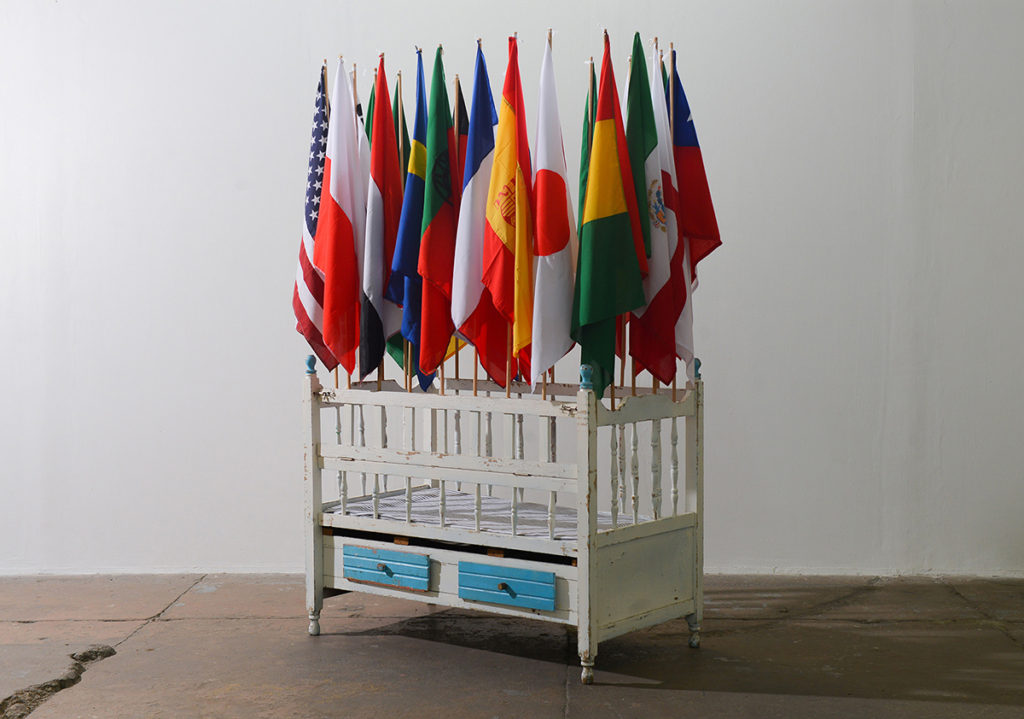
Fernando Poyón, Espacio de inmigración, wood, cloth, and sponge, 2018. Photo by Andrés Asturias.
22 Bienal de Arte Paiz
Lost. In Between. Together
May 6, 2021 – June 6, 2021
https://22bienal.fundacionpaiz.org.gt
The Paiz Foundation for Art and Culture is delighted to announce initial details for the 22 Bienal de Arte Paiz, which will take place in three locations in Guatemala City and four locations in Antigua Guatemala. Curated by Alexia Tala, chief curator, and Gabriel Rodríguez, adjunct curator, the Biennial will feature 40 artists in its central exhibition and two special individual exhibition projects on Guatemalan artist Aníbal López and Chilean artist Paz Errázuriz.
Titled Lost. In Between. Together – a reference to a publication from 2013 by BAK’s New
World Academy, edited by Jonas Staal, Yoonis Osman, and the collective We Are Here – the 22 Bienal de Arte Paiz invites visitors to reflect on the situation of perpetual crisis that affects the Global South. With Guatemala as a point of departure to investigate the cultural and geographical diversity of Latin America and beyond in the Global South, Lost. In Between. Together. explores the complexity of interpreting the past and looking to the future.
The approximation of the 22 Bienal de Arte Paiz towards issues around contemporary and ancestral history, interculturality, forms of knowledge and violence aims to establish points of encounter between art and the current context. The curatorial theme Lost. In Between. Together. seeks to focus on the ability of the Global South to tell its own story, with an observant look at both its roots and its present, reuniting artistic expressions marked by activism, the awareness of human rights and the power of certain geographies, or artistic expressions linked to traditions and ancestral knowledge where art often encroaches in the territory of the sacred. These artistic expressions will be encountered across the three thematic lines of the central exhibition: Pasts. Eternal. Futures, Perverse Geography / Cursed Geographies, and Universes of Matter.
Pasts. Eternal. Futures puts the focus on historical presentism as an error of analysis. It is a thematic axis addressing artistic processes that highlight events, stories, micro-histories and identities related to the contemporary history of the Global South. The two special projects, exhibitions of work by Aníbal López (1964–2014, Guatemala City) and Paz Errázuriz (1944 Santiago, Chile), offer an opportunity via these two key figures, to understand the contemporary art scene in Latin America and develop a series of reflections on the sense of “no way out” at which Lost. In Between. Together hints, as well as potential forms of catharsis. These two projects feature an artistic production that has been developed in contexts related to Indigenous cultures, or situations linked to marginalization, race and ethnicity.
Aníbal López‘s survey is the very first retrospective of the Guatemalan artist, who passed away in 2014. His artistic career offers a broad reflection on the ethical and moral repercussions of power dynamics in Central America and presents a strong critique of the art system. The exhibition starts with his beginnings as a painter, where his provocative works featuring images of the dead and religious figures with naked bodies and transgender people found a perfect target in the Catholic conservatism of Guatemala, and spans to the artist last years to include emblematic works such as ‘El Préstamo’ (‘The Loan’ 2000), or the work ‘Testimonio’ (‘Testimony’ 2012), presented at the 12th edition of documenta. Among over 80 artworks from private and public collections, the “Oral Archive” project occupies a special role. An ongoing project and a commission by the 22 Bienal de Arte Paiz, it aims to safeguard testimonies by collaborators of the artist from all over the world.
Paz Errázuriz’s solo exhibition covers over 40 years of the Chilean photographer’s work, including new pieces created in Guatemala, which represent the first works produced by Errázuriz outside of Chile. Several emblematic photographic series, including ‘Adam’s Apple’ (‘La Manzana de Adán, 1982–1990), ‘Sea Nomads (‘Nómades del Mar’ 1991–1995) and ‘The Infarct of the Soul (El Infarto del Alma, 1992–1994), are accompanied by two new series that relate to the artist’s research on the local context. ‘Trans Guatemala’ (2019) is a series of works in collaboration with the Guatemalan transgender community, while ‘Sepur Zarco’ reveals, for the very first time, the faces of the Guatemalan women involved in the homonym trial case. This is the first case of women from the Mayan community who have denounced the sexual violence perpetrated by soldiers during the civil war that tore the country apart for 36 years. The Sepur Zarco represents the first time in Guatemala that official charges by Indigenous women made it to court; translation to a Mayan language was required during the trial; and, for the first time, military personnel were tried and convicted for crimes of domestic and sexual abuse and slavery.
Artists list: Francisca Aninat (Chile), Hellen Ascoli (Guatemala), Ana Teresa Barboza (Peru), Marilyn Boror (Guatemala), Edgar Calel (Guatemala), Sebastián Calfuqueo (Chile), Benvenuto Chavajay (Guatemala), Manuel Chavajay (Guatemala), Jonathas de Andrade (Brazil), Emo De Medeiros (Benin), Detánico & Lain (Brazil), Elimo Eliseo (Guatemala), Paz Errázuriz (Chile), Forensic Architecture & Forensic Oceanography (United Kingdom), Rafael Freyre (Peru), Wingston González (Guatemala), Antonio José Guzmán (Panama), Yasmin Hage (Guatemala), Ayrson Heráclito (Brazil), Diego Isaías Hernández (Guatemala), Jessica Kairé (Guatemala), Vanderlei Lopes (Brazil), Aníbal López (Guatemala), Oswaldo Maciá (Colombia), Nelson Makengo (Congo), Andrea Monroy (Guatemala), Uriel Orlow (Switzerland), Alejandro Paz (Guatemala), Oscar Eduardo Perén (Guatemala), Antonio Pichillá (Guatemala), Ángel Poyón (Guatemala), Fernando Poyón (Guatemala), Naufus Ramírez Figueroa (Guatemala), Naomi Rincón Gallardo (Mexico/USA), Óscar Santillán (Ecuador), Maya Saravia (Guatemala), Angélica Serech (Guatemala), Jonas Staal (Holland), Pablo Vargas Lugo (Mexico), Heba Y. Amin (Egypt).