
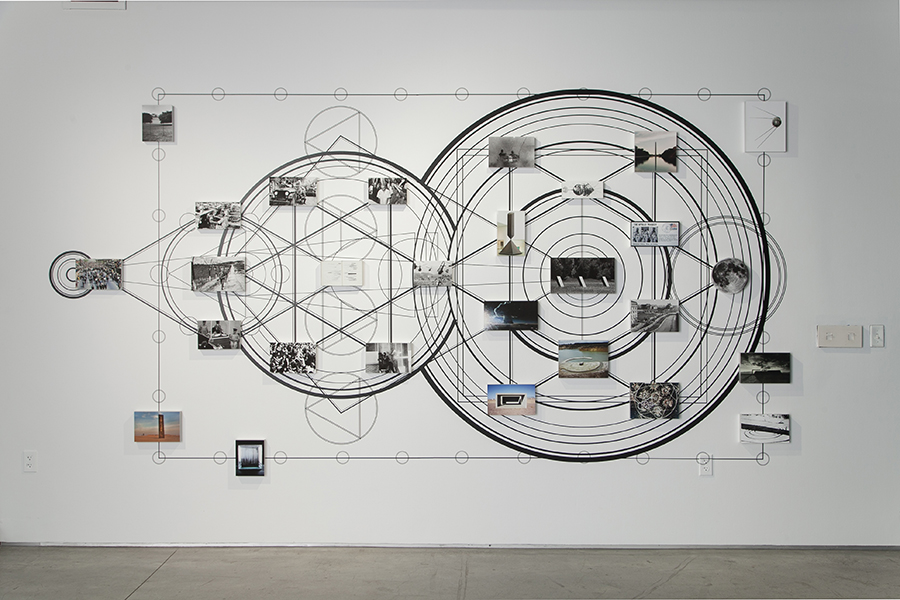
Image courtesy of the Ural Industrial Biennial of Contemporary Art
The 5th Ural Industrial Biennial of Contemporary Art
Immortality
September 12 – December 1, 2019
https://uralbiennale.ru
The 5th Ural Industrial Biennial will take place from September 12 to December 1, 2019 in the city of Ekaterinburg at two venues: The Ural Optical and Mechanical Plant and the Coliseum Cinema. The Main Project features 75 artists and collectives from 25 countries and regions. The list includes world-famous Carlos Amorales, Cristina Lucas, Pavel Pepperstein, Adrian Piper, Diana Thater and Anton Vidokle, announced in April, as well as Felix Gonzalez-Torres, Shimabuku, Charlotte Posenenske, Alain Resnais and Chris Marker.
Responding to the overarching framework of “Immortality”, the 5th Ural Biennial seeks the possibilities of multiple futures. By probing into various historical junctures, the project explores the catalytic moments that could lead to the interruption and diversion of the global temporal axis’s synchronization process. It challenges the prevailing belief that technological acceleration would lead us to the end of history, to a singularity. The exhibition rejects the politics of acceleration as the only means of transcending traumatic circumstances in recent history and resolving current social and political crises. The concepts of immortality depart from the anticipation of the homo deus and metamorphose into various philosophical and aesthetic ponderings. How can we overcome, not death, but immortality?
Having these reflections in mind, the biennial will commission more than 10 new works to respond critically of the curatorial premise, from artists Zarouhie Abdalian and Joseph Rosenzweig, Agency of Singular Investigation, Evgeny Antufiev, Vladislav Efimov, Markelova Ksenia, Gabriel Lester, Qinmin Liu, Liu Qingyuan, Christian Nymapeta, The Recycle Group, Anastasiya Tsayder, Yan Xing, and among others.
This biennial’s main project, for the first time will feature about a third of its participating artists from Russia. The curator – Xiaoyu Weng, has done extensive research in the country and made meaningful connections with the local art scene to include more familiar names to Russian audience such as Alexander Shishkin-Hokusai and emerging talents such as Ivan Petrokovich and Ustina Yakovleva.
“The magic of numbers is important for this biennial. The fifth project means that we have gone through 10 years of work. During this time, we have established the main tasks: to work with the local industrial context, to create unique environment for producing new artworks, to discover new names, and to study relevant themes of the global artistic agenda. The greatest international professionals have been working with us, and this year we are glad to cooperate with the renowned expert Xiaoyu Weng, Curator at the Solomon Guggenheim Museum, New York. The topic of Immortality that frames this year’s edition deals with the changes that take place in today’s world, which is in line with the previous editions devoted to mobilization and the new literacy”.
Alisa Prudnikova, Commissioner of the Ural Industrial Biennial, Director for the Regional Development at the Museum and Exhibition Center ROSIZO
“Inspired by philosopher Yuk Hui’s proposal of rediscovering different cultures’ cosmotechnics, the exhibition puts the homogenous technological future in question. When ghosts of ancient or recent history resurface alongside the rise of new technologies, we might start to ask whether new technical powers are forcing a confrontation with deeply-seated contradictions by bringing forth a so-called efficient and automatic system in exchange for the traditional values and forms of life. Many of the artists live and work out of places that are not their cultural backgrounds and origins. Such complexity is very important in foregrounding different cosmologies and multi-layered perspectives in thinking and practicing technology historically and its relationship with humanity’s future”.
Xiaoyu Weng, Curator of the Biennial’s Main Project
Weng invites us to think further of these questions: “What is at stake in the futurity illustrated by human-machine hybrid, artificial intelligence, perfect emotional control, memory transplantation, smart cities, and space immigration? But what happens when there is unfinished business in the past? How can we reject a linear path attached to the image of technological progress?”
The Ural Optical and Mechanical Plant is part of the Shvabe Holding (Rostec Group) and is one of Russia’s leading optical enterprises. The plant is undergoing renovation, thus the temporarily vacant space will be available to host the exhibition project and a large number of visitors. The opportunity of organizing an international exhibition of such scale in an operating factory is unprecedented in the history of the Ural Biennial. It provides a unique perspective on the historical development of industrial production and its long-lasting and intricate relationship with art practice.
The second venue of the Biennial is the Coliseum Cinema – the oldest movie theater in Ekaterinburg built in 1845, located in the city center. During the Biennial, the cinema’s auditorium and lobby will transform to open classes for public access and interaction. In addition to featuring artworks of the Main Project, it will also be the home for the public programs.
“Rostec acts as strategic partner of the Biennial for the second time. But this is the first time we host the exhibition at one of our factory facilities. The Shvabe Holding’s philosophy extends to the transformation and improvement of human life and its quality. The history of the factory echoes with the Biennial’s framework – Immortality, as it has witnessed the turbulent war times and interacted with generations of workers. We are convinced that today’s industry holds a huge share of creativity. The biennial provides an opportunity to see our industry in a new way, to experience the unique industrial aesthetics, and to understand the production facilities and the products we make”.
Ekaterina Baranova, Director of Communications at the Rostec State Corporation
Tickets for the Main Project of the 5th Ural Industrial Biennial of Contemporary Art will be available at the venues and at the official website of the project. To enter the territory of the Ural Optical and Mechanical Plant, visitors will be required to present their passports. Foreign citizens will be required to register online 5 working days prior to the visit. The website with registration forms and online ticket sales is scheduled to be launched in late June.
To view more detailed information, please visit: uralbiennale.ru