Interview with Bose Krishnamachari, President of the Kochi Biennale Foundation* and Director of the Kochi-Muziris Biennale** (http://www.kochimuzirisbiennale.org/).
Interview submitted on November 24th 2020
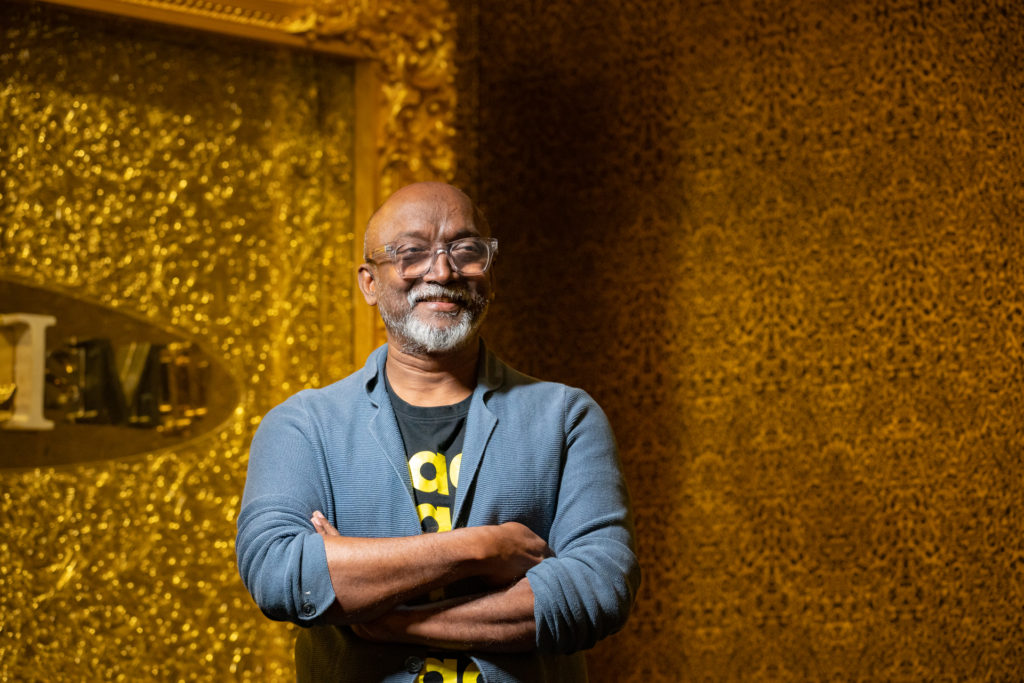
Bose Krishnamachari. Courtesy Kochi Biennale Foundation
IBA: Can you give an account of what the situation is with your project and how the crisis affected it? Specifically, as you have recently announced the postponement to next year of the 5th Kochi-Muziris Biennial.
Earlier on, we had continued to work towards the originally scheduled opening date (December 12th), hoping to realise a partially physical exhibition with strong virtual elements. However, with the pandemic having shown no signs of abatement in India, the state of Kerala having slipped into a second spike of cases, prolonged travel restrictions, and generally unfavourable conditions on-ground, we decided to move the opening of the Biennale to November 1, 2021, in faith that circumstances by then would be conducive for visitors, artists, staff, and others for a safe and complete Biennale gathering.
We consider this extension as an opportunity that will allow for a better production schedule, both in terms of the works that will be a part of the exhibition, and the production of the exhibition itself. The extension has not affected the participation of any of our artists so far.
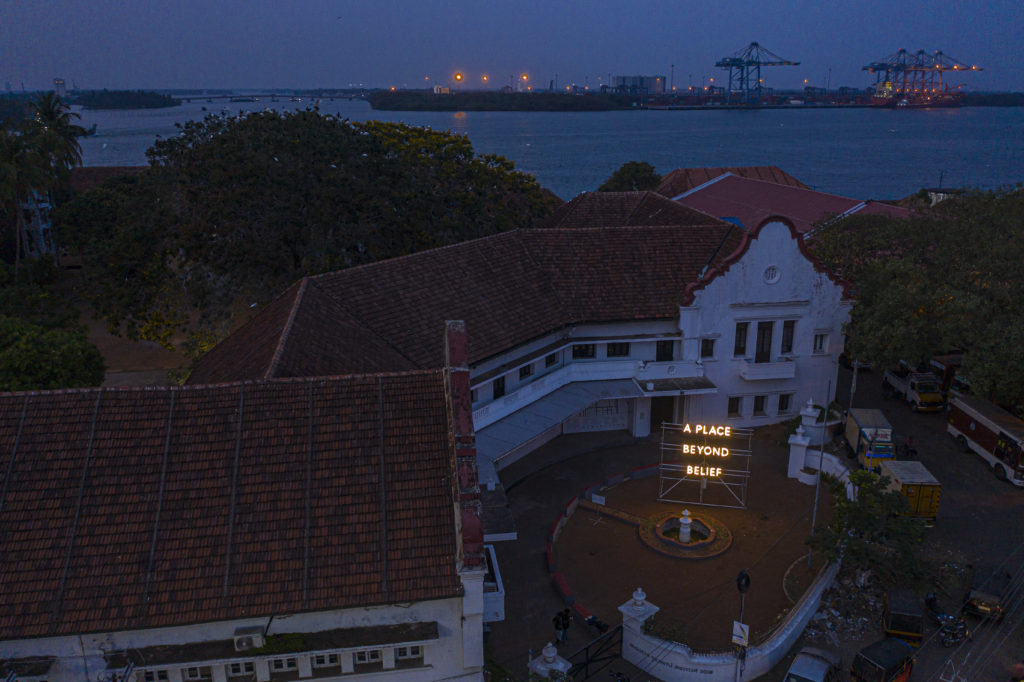
Nathan Coley, ‘A Place Beyond Belief’, Illuminated text on scaffolding / 6x6x3m, Aspinwall House, Kochi-Muziris Biennale 2018. Courtesy Kochi Biennale Foundation
IBA: Did this impact the way you chose to work with the artists (travel limitation etc) and give us a sense of how you developed a new approach?
I’m sure something like the pandemic will produce inflections in artist proposals. Earlier, when we had aimed for a December 2020 opening, Shubigi Rao (Curator of the upcoming 5th Kochi-Muziris Biennale) had worked with the artists in reviewing and revising proposals to suit the circumstances. I anticipate another iteration of revisions now.
So far, we’ve tried to work around obstacles like travel restrictions by assuming production of works remotely. We’re hoping that they will further ease soon, so we can safely begin on-site work as well.
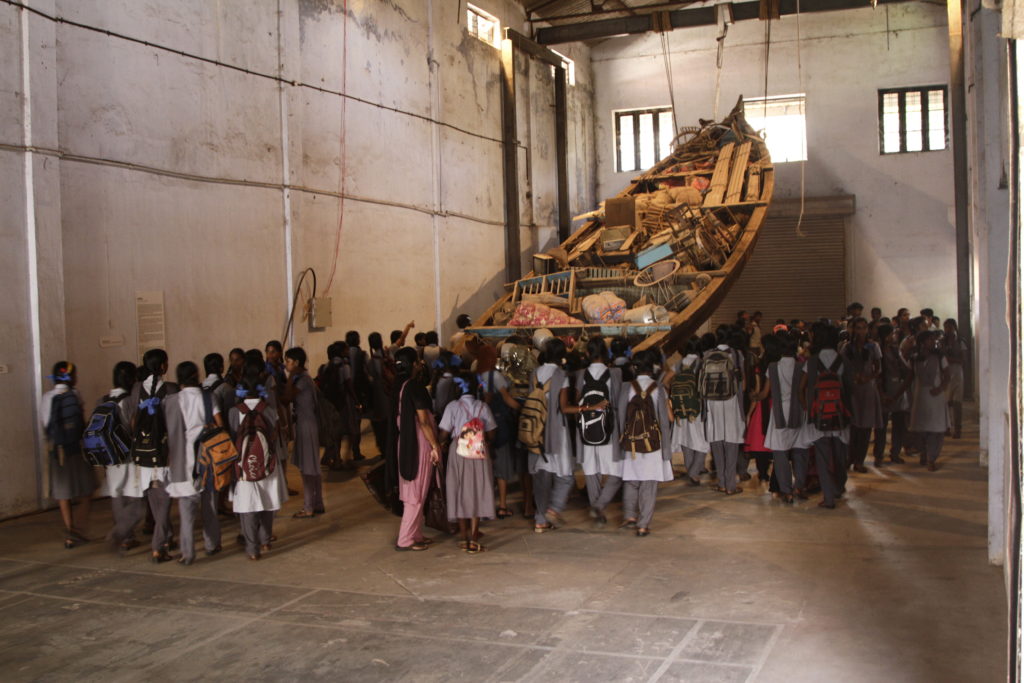
Subodh Gupta, Untitled, Boat, Wood, Found Objects, Aspinwall House, Kochi-Muziris Biennale 2012. Courtesy Kochi Biennale Foundation
IBA: As an institution that interacts more than others with the wider urban fabric do you feel this can also be a moment to re-think a “neighbourhood” relationship with the audience?
The question of relation to location has always been important. This is part of the brief given to the curator. Also, more long-term projects happen along these lines in the residency programme and show. Our throughout-the-year residency and ABC programmes engage with the immediate neighbourhood and our local audience. Even in the at-home programme, we’ve tried to include the schools from fort kochi-mattancheri.
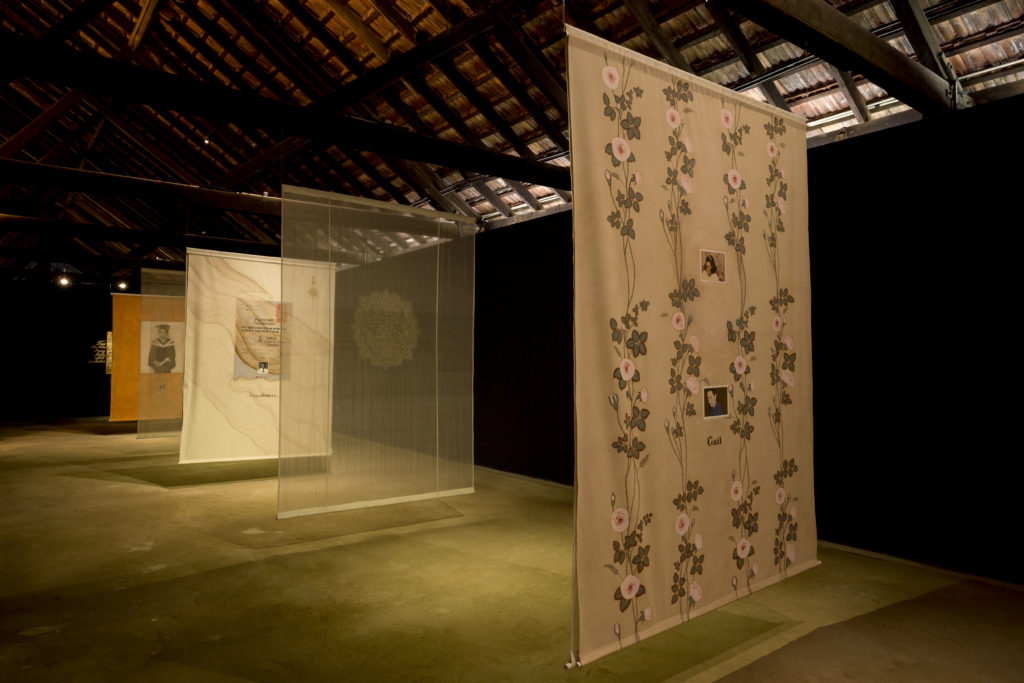
Desmond Lazaro, ‘Family Portrait’, Installation with hanging cloth, small paintings, video (5.07 min), icon with gilded gold leaf, Aspinwall House, Kochi-Muziris Biennale 2016. Courtesy Kochi Biennale Foundation
IBA: Is this also an opportunity to reflect on the sustainability of the model in the long term?
The biennale is conceived as the largest, yet only one of the programmes of the foundation. The educational and other programming happens throughout the year, and across constituencies – fine arts students, children, young artists, various publics. We have invested in the form and possibilities of the large-scale exhibition, but we treat it as the anchor for pedagogic programmes, research, cultural collaborations, meeting grounds and other actions.
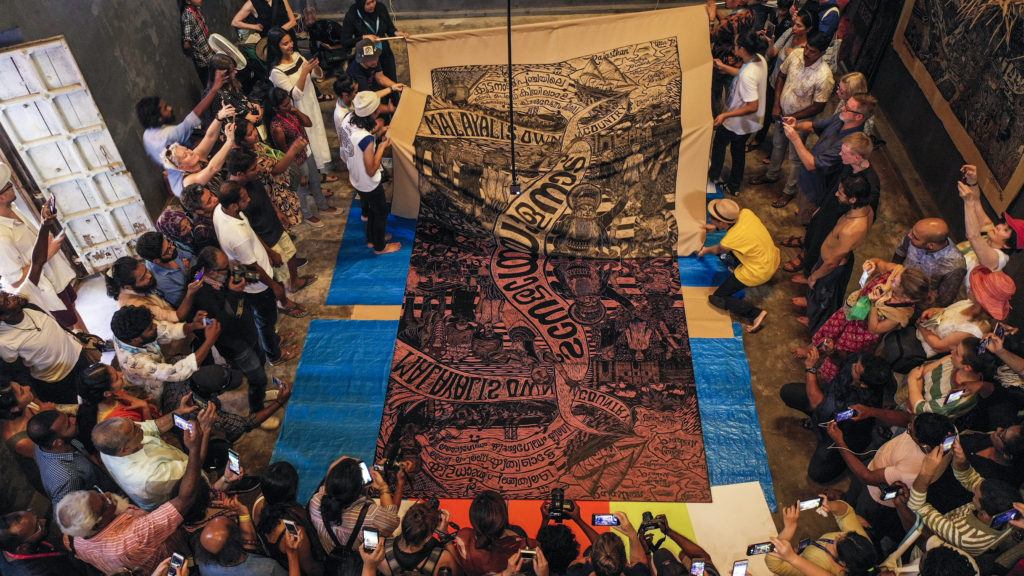
Pangrok Sulap, Performance during opening week, From the series of woodblock print (2014-2018) / Offset ink on blackout cloth, Anand Warehouse, Kochi Muziris Biennale 2018. Courtesy Kochi Biennale Foundation
IBA: Can you give us an example/idea about how the IBA network represents a resource in these circumstances?
IBA has been an excellent support network for arts organisations like ours, during these times. We’ve been able to learn so much from other organizations – how they overcame challenges posed by the pandemic, and the adaptations made in their ways of functioning, to suit our times.
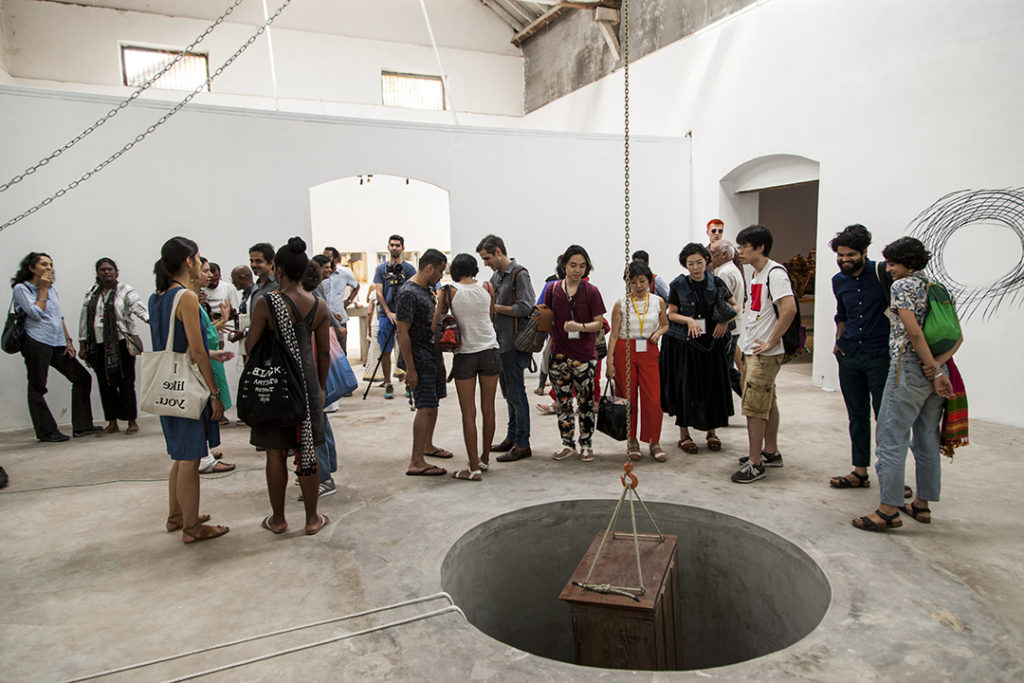
Aki Sasamoto, ‘Random Memo Random’, Installation with performance and video documentation, TKM Warehouse, Kochi-Muziris Biennale 2016. Courtesy Kochi Biennale Foundation
IBA: Has this situation sparked a support in your region for artists/art institutions? Have you undertaken direct measures in this sense?
It has sparked some support, I would say. But support for art institutions/artists has been relatively much lower this year.
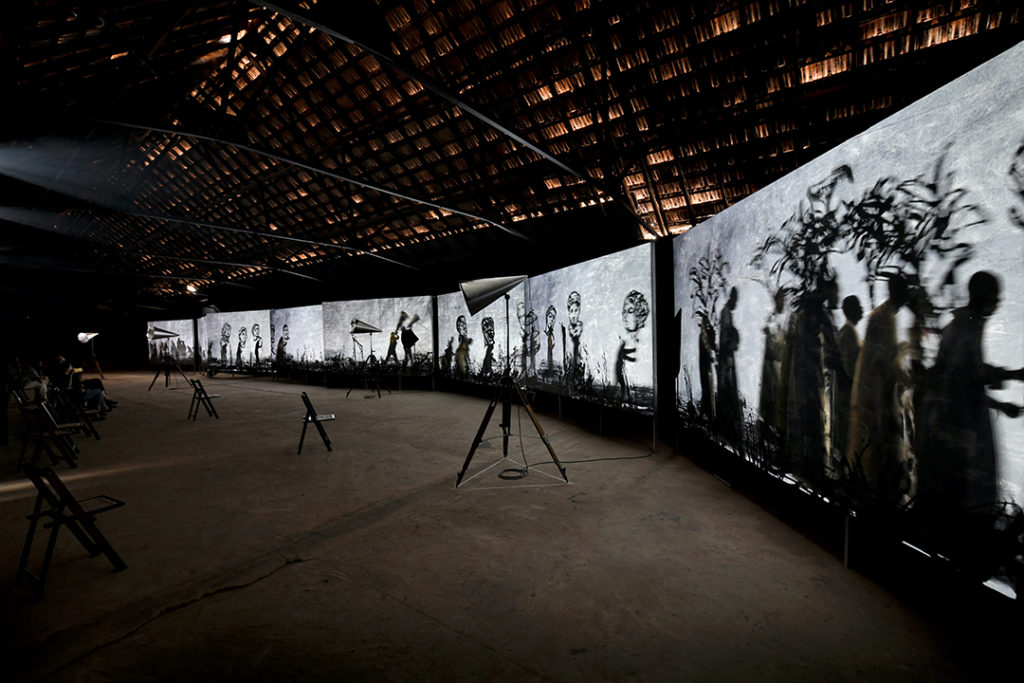
William Kentridge, ‘More Sweetly Play The Dance’, Eight –channel video installation / 15 mins, looped. Aspinwall House, Kochi-Muziris Biennale 2018. Courtesy Kochi Biennale Foundation
*: The Kochi Biennale Foundation is a non-profit charitable trust engaged in activities related to education and promotion of art, and culture in India. Primary among its objectives is the establishment and conducting of the Kochi-Muziris Biennale in the city of Kochi, Kerala, every two years. The Kochi Biennale Foundation works round the year to broaden public access to art across the country through a diverse range of programs.
**: The Kochi-Muziris Biennale is an international festival of contemporary art hosted in the city of Kochi, in Kerala, India. It is India’s largest contemporary art event, and the largest public exhibition of this nature in South Asia. The landmark event has created an enduring platform for artistic and cultural contributions to society and has established itself as a centre for artistic engagement in this part of the world. The four editions of the Kochi-Muziris Biennale, since 2012, have ensured that Kochi occupies a prominent position on the global art calendar. The Biennale has exhibited more than 400 artworks by over 350 artists from all over the world and hosted more than two million visitors.