
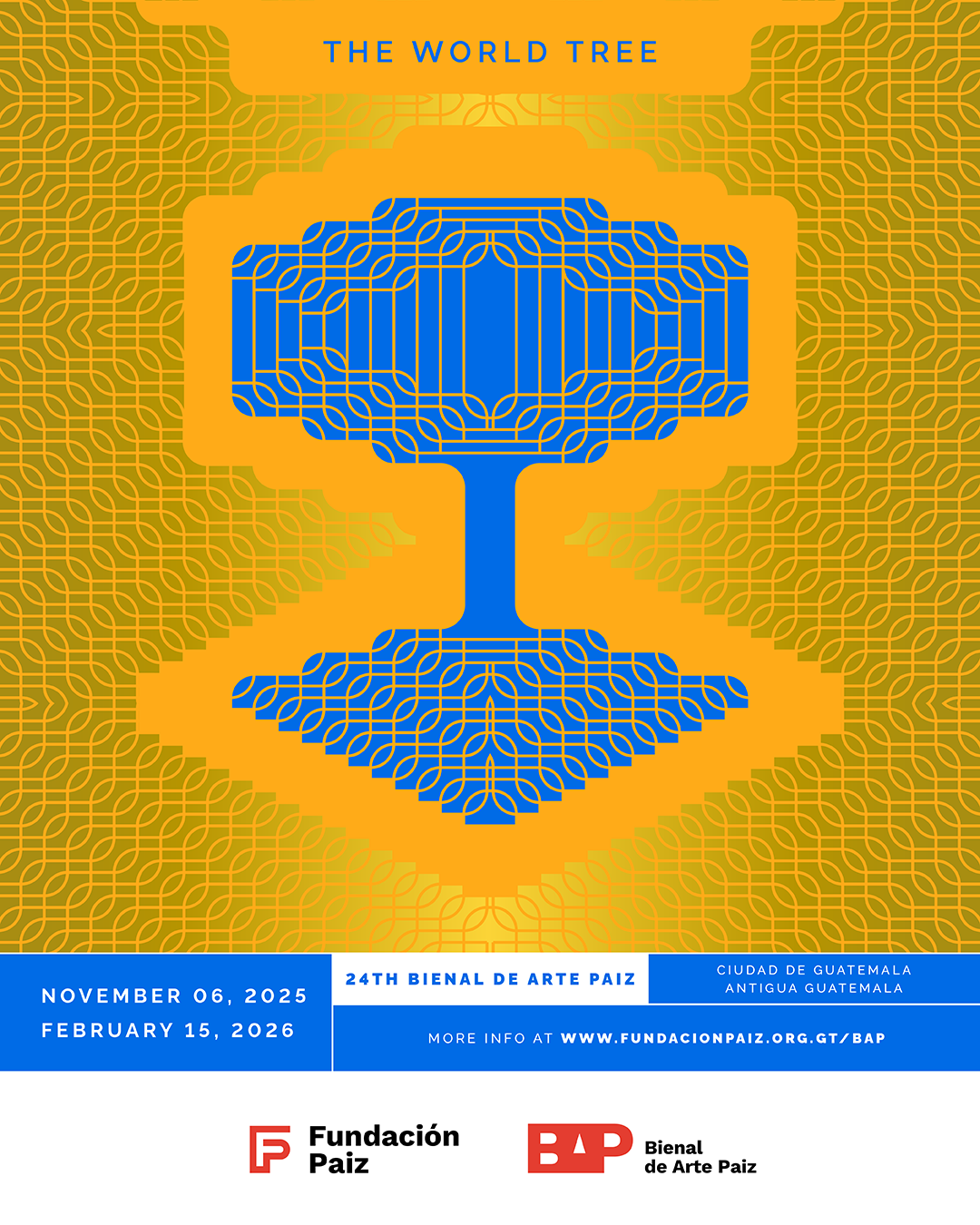
24th Paiz Art Biennial – “The World Tree”
November 6, 2025 – February 15, 2026
Curator: Eugenio Viola
Guatemala City & Antigua Guatemala
fundacionpaiz.org.gt/bap
The Fundación Paiz para la Educación y la Cultura [Paiz Foundation for Education and Culture] is pleased to announce the preliminary list of participants in the 24th edition of the Paiz Art Biennial, titled The World Tree. Curated by Eugenio Viola—renowned critic and Artistic Director of MAMBO (Museo de Arte Moderno de Bogotá)—this edition brings together a polyphonic selection of artists from Guatemala and around the world. It affirms the Biennial’s role as a vital cultural platform for Mesoamerica and beyond.
Viola describes “The World Tree” as a project that “symbolizes our histories, challenges, and aspirations through its trunk, branches, and leaves. Its roots spread in multiple directions, reflecting a dynamic and complex system, comparable to a network connecting nodes of information in constant interaction.” He adds: “Complexity defines our era. Digitalization, cultural hybridization, and the rapid pace of political, social, and economic changes intertwine in an interconnected network.”
In response, this edition gathers artists “from all five continents, from diverse backgrounds and generations, whose works boldly confront the wounds and contradictions of the present. Many of them are ‘journey companions,’ an essential part of my human and professional path, with whom I have collaborated throughout my career. This choice embodies my curatorial vision, where each exhibition is a visual essay that forms part of a broader and ever-evolving discourse, a narrative that is consistently built over the years.”
The preliminary list includes: Maria José Arjona / Kader Attia / Erick Boror / Seba Calfuqueo / Jeffry Càn / Tania Candiani / Ali Cherri / Maria Adela Díaz / Adji Dieye / Elyla / Regina José Galindo / Ana Gallardo / Ximena Garrido-Lecca / Igor Grubić / Dor Guez / D Harding / Voluspa Jarpa / Alevtina Kakhidze / Kite / Jorge de León / Luz Lizarazo / Carlos Martiel / Tuan Andrew Nguyen / Chelsea Odufu / ORLAN / Antonio Pichillá / Veronica Riedel / Christian Salablanca / Jaanus Samma / Mithu Sen / Hiraki Sawa / Balam Soto / Jennifer Tee / Gian Maria Tosatti / Simón Vega / Zhang Xu Zhan.
In total, twelve Guatemalan artists are featured in this preliminary selection. Six were chosen through an open call—Jeffry Cán, María Adela Díaz, Jorge de León, Verónica Riedel, Balam Soto, and Martín Wannam—while others, including Regina José Galindo, Antonio Pichillá, and Erick Boror, were invited.
Boror was also invited to visualize the concept of the Biennial. His design reinterprets the powerful image of the “sacred tree of life,” integrating contemporary values of interconnectivity and globalization. The result is a stylized tree rendered in geometric and abstract patterns, offering a vibrant dialogue between the ancestral and the contemporary.
Viola explains that “‘The World Tree’ establishes powerful connections between territories united by narratives of resistance, displacement, and memory, forging a transversal dialogue between the Global South and the rest of the world. Voices from the Global South occupy a central place, reinterpreting in aesthetic and political terms the ruins of history, the weight of memory, the legacy of colonialism, and the traumas of a globalized present that is increasingly intolerant. Coming from contexts of resistance and resilience, these artists transform the scars of the past and the tensions of the present into powerful visual narratives. Their works untangle the complexities of diasporas, challenge inherited power structures, and reclaim ancestral wisdom, proposing more equitable futures. By questioning dominant narratives, they weave a network of solidarity that transcends borders, celebrating a wide range of perspective.”
This year’s Biennial also presents a selection of pre-Hispanic Mayan archaeological pieces, in collaboration with the Ruta Maya Foundation. These objects—sculptures, monuments, figurines, incense burners, belt adornments, urns, and masks—date from the Early Classic to Late Classic periods (150/200–900 AD) and will be shown in dialogue with contemporary artworks. The curators describe this as a “meta-temporal collision” between past and present, myth and reality, paying homage to Maya cosmology’s cyclical worldview.
In addition, a curated selection of works from previous Biennial acquisition prizes—by artists such as Javier Azurdia, César Barrios, Santiago Beltrán, Carlos Fanjul, Lourdes De la Riva, Aníbal López, Sandra Monterroso, Paula Nicho, Ángel Poyón, Isabel Ruiz, Pablo Swezey, and Vinicio Villagrán—will also be on view. These works extend the Biennial’s historical narrative and engage with the themes of “The World Tree.”
“The World Tree” challenges traditional geopolitical frameworks and instead proposes “a decentralized and rhizomatic narrative that short-circuits cultural genealogies from Mesoamerica, the Caribbean, Latin America, Africa and its diaspora, Europe, the Middle East, Asia, Oceania, and key voices from indigenous and ancestral peoples.”
This edition reaffirms Fundación Paiz’s longstanding commitment to art as a force for reflection and transformation, and positions the Paiz Art Biennial as an essential platform for critical discourse and global artistic exchange.
About the Paiz Art Biennial A pioneer in the advancement and development of art in Central America, the Paiz Art Biennial is the region’s most significant contemporary art event since 1978, making it the sixth oldest Biennial in the world and the second oldest in Latin America. Through free activities and exhibitions, the Biennial offers multiple ways to access knowledge about contemporary art, bringing together artists, curators, critics, and both local and international figures. It serves as a platform for the exhibition, creation, and dissemination of Guatemalan artistic production. The Biennial is a cultural project of Fundación Paiz, a non-profit organization that, for over forty years, has supported the development of education and culture in Guatemala, with the conviction that art is an essential tool for social development.
Additional participants, venues, and details of the Biennial’s Public and Learning Programs will be announced in the coming months.