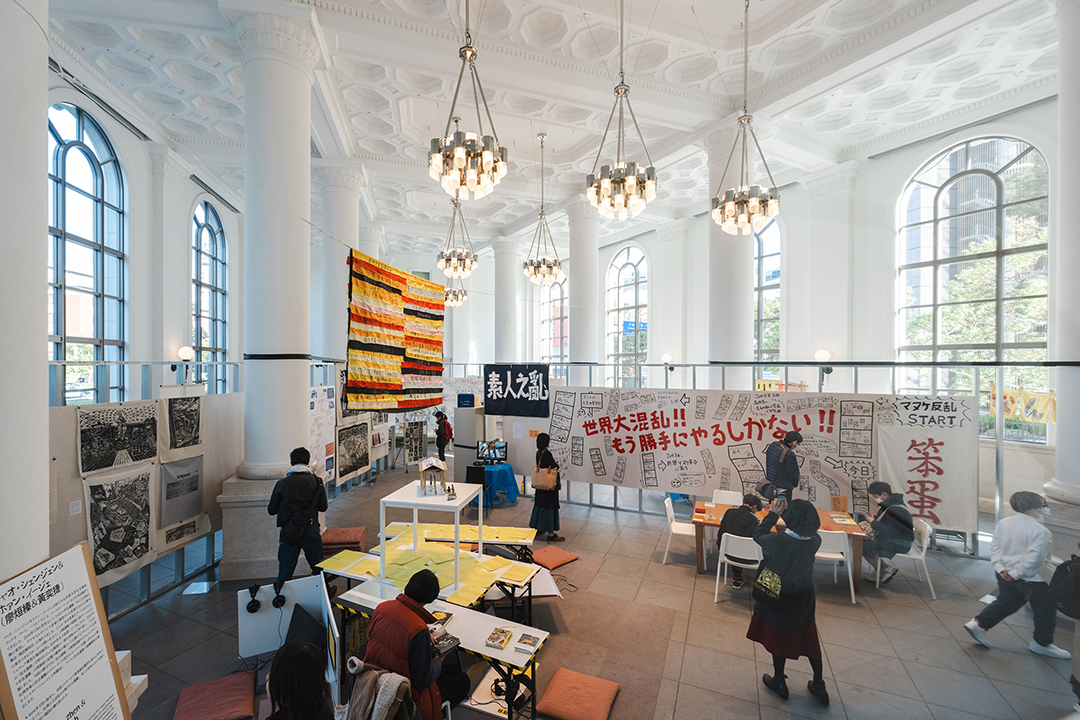
Installation view of the 8th Yokohama Triennale. Venue: Former Daiichi Bank Yokohama Branch. Photo: OHNO Ryusuke. Courtesy of Organizing Committee for Yokohama Triennale
IBA Stage: 8th Yokohama Triennale
May 8, 2024 (Wednesday)
4:00 pm (Yokohama/GMT+6)
The Yokohama Triennale has long been an active member of the Biennial Association community which makes it an even bigger honor to host them for the first time as part of our IBA Stage series. Present since the first General Assembly in Berlin 2014, Yokohama has itself been the host of our 4th General Assembly in September 2017 which took place during the staging of the 6th Yokohama Triennale.
This year’s exhibition, which opened on March 15th, is curated by Liu Ding and Carol Yinghua Lu and it is titled “Wild Grass: Our Lives”. The curatorial project unfolds through seven conceptual chapters staged throughout the city of Yokohama in five different venues: Yokohama Museum of Art, the Former Daiichi Bank, BankART KAIKO, Queen’s square and the Motomachi-Chūkagai Station Accessway.
The curators were inspired to “search for an exhibition theme that [spoke] of humble humanism, courage, resiliance, faith, and solidarity” during a phase of recent global history in which, as the world was recovering from the COVID-19 pandemic and its societal as well as personal/psychological consequences. The title of the exhibition is borrowed from “Chinese writer Lu Xun’s (1881–1936) anthology Wild Grass, penned from 1924 to 1926, during a turbulent period in Chinese history. Its 23 essays portrayed the personal and social realities that confronted him. For Lu Xun, the greatest sense of crisis and defeat came from the 1911 Xinhai Revolution.” This seminal work of literature underlines and acknowledges the despair of an old regime disappearing without the new one bringing in the reforms and changes it longed for.
From the curatorial text:
“The exhibition theme “Wild Grass: Our Lives” aspires to Lu Xun’s philosophy of the universe and life. It doesn’t just call to mind the image of a fragile and defenseless existence, inconspicuous and alone, in the wilderness, with nothing to fall back on. It is also a symbol of a life force that’s unregulated, irrepressible, defiant, self-motivated, and prepared to fight alone at all times. Furthermore, there is no ultimate state of existence to arrive at. Every state of being is a mediation and a process in itself, where there is no victory or failure but only a perpetual state of internal movement. Thus, every state of being is potentially a messenger for each other, mediating for each other. These philosophical propositions are not abstract; they exist vividly in the world of experience, and are the experiences themselves. “Wild Grass” signifies a philosophy of life that elevates their repressible force of individual life to a respectable existence that transcends all systems, rules, regulations, and forms of control and power. It is a model for flexible expression of subjectivity.”
“In the 8th Yokohama Triennale, we wish to revisit a selection of historical moments, events, figures, and trends of thoughts since the beginning of the 20th century. Some examples include the resonance of Japanese and Chinese left wing wood cut movements in the early 1930s, the rise of subjective imaginary in the postwar cultural construction in East Asia, the reflection on modernity after the global radical movements of the late 1960s, and the critical and emancipatory energy of postmodernism in full swing in the 1980s. On this basis, we draw inspiration from the anarchist practices and thoughts that have emerged since the proposal of the end of history, to explore options for possible dialogue between individuals and established rules, and institutions. In this Triennale, we prioritize the relationship between art and its intellectual underpinnings and champion the engagement of art with reality. We hope to generate a new imaginary of global friendship in the name of art, and call for the promising union of the spirit of individual internationalism and weak signals.”
“To conclude, we imagine the making of the entire Triennale as composing a symphony from several aspects. On the one hand, we revisit several instances of individuals exploring possible ways of spiritual and cognitive self-constructions during the modern history in East Asia. As such, we hope to ignite people’s desires and efforts to discover and recognize their own agency in our contemporary lives. On the other hand, we promote a sense of urgency in encountering our times and reconstructing the relevance of the individual in driving changes in this world. We do so by presenting works involving engagements from personal perspectives of the present with today’s cultural and political landscapes. At the same time, we will portray some of the theoretical references and practical approaches of activist movements in East Asia since 2000, which have helped alleviate the plight of the subjects under the statute of modernity. We lay out these aspects as ways of self- emancipations while facing up to the status quo of the individual who is constantly being regulated, weakened, and inhibited in the contemporary order of life. We hope to inspire people to actively discover ways of living beyond what is prescribed to us by the current system, to think and explore worlds outside of existing boundaries, limits and orders of things.”
The seven chapters around which the curatorial project is developed are: Our Lives, My Liberation, All the Rivers, Streams and Rocks, Dialogue with the Mirror, Fires in the Woods, and Symbol of Angst. The first of these, Our Lives, which is displayed in the historical home of the Triennale at the Yokohama Museum of Art, takes the form and investigates the notion of the state of exception through a reflection on camps – as a reflection on refuge, exile, wandering, protest, wartime, disasters but also reunion. Looking at the past few years as well as reflecting on the upcoming challenges humanity will have to face with climate change and global tensions, the approach chosen by the two curators seems very fitting. The inclusion of many artists and collectives active not only in the field of art but also as activists and researchers makes of this project something we really look forward to hearing more about!
To read more about the exhibition and Ding and Yinghua Lu‘s research as well as the complete artist list of the 8th Yokohama Triennale follow this link.
As always IBA Stage events are meant as a moment to hear about a project through its makers and have the opportunity to participate in a Q&A session at the end of the presentation.
Click here to register for the event or follow us through our usual social media channels.